
White label grooming products are one of the few consumer electronics plays where a brand can move from first inquiry to sellable stock inside a single quarter. The reason is structural: established factories maintain proven platform models—devices already engineered, tooled, certified, and refined across years of production—that a brand can customize with its own logo, colors, and packaging instead of funding new development. Most private label projects at this level reach sellable inventory in about three months. The strategic question is not whether the model works but which category to enter first. This guide walks through seven categories of white label grooming products you can realistically launch this quarter, with the platform specifications, audience logic, and positioning trade-offs of each.
What makes white label grooming products launchable in a single quarter?
Speed comes from what you skip. On a platform model, industrial design, tooling, component sourcing, and reliability refinement are already done and already paid for across earlier production runs. The typical sequence with an established factory looks like this:
- Samples of existing platforms in 7–14 days.
- Customization confirmed—logo printing or engraving, housing colors, gift-box packaging, manuals in your market’s languages, comb and accessory combinations.
- Mass production typically 45–60 days after order confirmation, at MOQs typically between 1,000 and 3,000 units per model.
- Certifications—CE and RoHS for the EU, PSE for Japan, FCC for the US—applied per target market and confirmed per model.
The terms “white label” and “private label” are used interchangeably in this category; the distinctions that actually matter are explained in our comparison of private label, OEM, and ODM. What follows uses real platform models from the KUNNEX line as concrete reference points—each one manufactured in an ISO 9001 certified Taiwan factory with in-house blade heads, motors, and battery systems.
Which white label grooming products should you launch first?
1. Nose and ear trimmers—the classic entry category
Nose trimmers are compact, inexpensive to ship, and bought year-round, which makes them the most common first product for new grooming brands. The category rewards quality disproportionately: a badly made nose trimmer pulls hair, and buyers say so in reviews. Platform options span three positioning tiers—a premium tier such as the MB-061 (Japan stainless steel blade, MABUCHI motor, whole-piece waterproof, 90 minutes on one AA battery, three stock housing colors), a washability-focused tier such as the MB-041 with its water-suction cleaning function, and a design-led tier such as the MB-051 pen-type model in an aluminum case at just 22 grams. See the nose hair trimmer line for the full range.
2. Beard trimmers—the largest audience
Beard care is the volume heart of men’s grooming, and the platform depth reflects it. The MB-342B pairs a Japan high-carbon steel blade and MABUCHI motor with USB Type-C charging, an IPX8 waterproof rating, and dual heads—wide plus detail—with 3/4/5/6 mm combs. For battery-operated positioning, the MB-042 wet and dry groomer runs 90 minutes on a single AA with combs covering 2–14 mm. Beard trimmers support higher price points than nose trimmers and give a brand room for a good-better-best ladder. The beard trimmer platforms page covers current configurations.
3. Multifunction grooming kits—the gifting workhorse
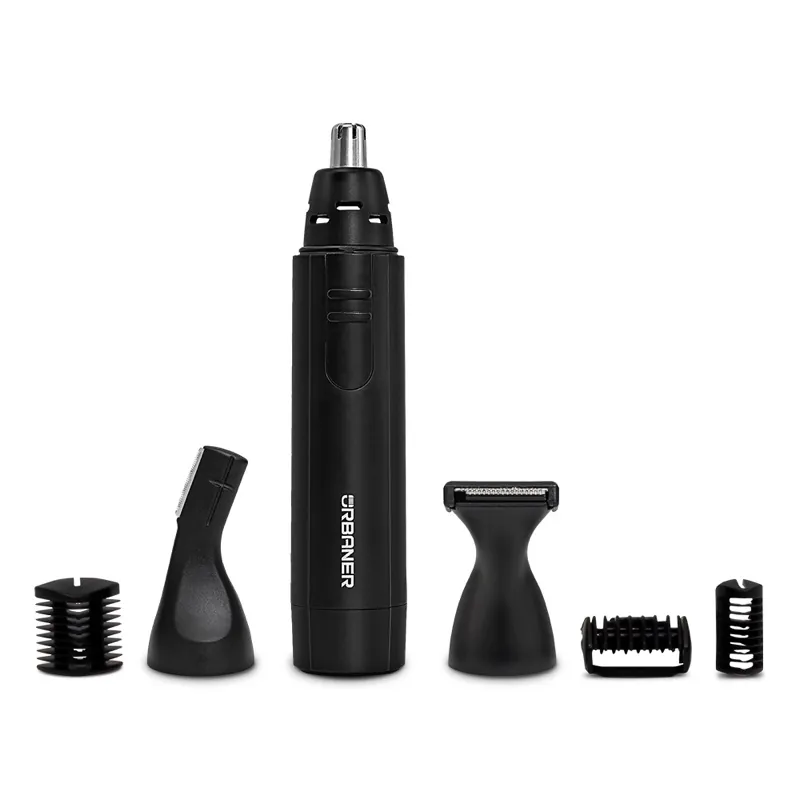
Kits bundle several blade heads on one handle and outsell single-function devices in Q4. The MB-980 is the reference platform: nose, beard, and eyebrow heads, Japan high-carbon steel blades, MABUCHI motor, IPX8 fully washable, roughly 90 minutes on one AA battery, 55 grams—delivered in a gift-box format designed for retail shelves. On multifunctional platforms, the blade-head combination itself is customizable, so two brands can build visibly different kits from the same engineering base.
4. Hair clippers—home cutting and barber-grade tiers
Home hair cutting settled into a durable habit, and clippers now span two distinct buyer groups. For family use, the MB-134 dual-head waterproof clipper runs 150 minutes on two AA batteries with combs from 0.4 to 6 mm, and the MB-034 offers an entry price point with a Sandvik steel blade. For enthusiast and barber-grade positioning, the MB-133 uses a ceramic and Sandvik blade combination that runs roughly 70 percent cooler than an all-steel blade—a genuine, explainable differentiator for long cutting sessions—with USB charging and combs from 1 to 12 mm. Details on the hair clipper line.
5. Travel and pocket shavers—the impulse price point
Small-format shavers occupy the gift, travel, and add-to-cart niches that bigger devices cannot. The MB-043 pocket shaver is a foil-system unit smaller than a business card—8×4×1 cm and 47 grams—running 90 minutes on one AA battery. Low price points make this category effective for market testing: a brand can learn a marketplace’s dynamics before committing to premium inventory. The broader electric shaver range extends the same logic upward.
6. Body groomers—the fastest-growing use case
Body grooming has moved from niche to mainstream across the US, EU, and Japan, and purpose-built platforms matter here because facial trimmers handle the job poorly. The MB-333B washable body shaver and trimmer combines a Sandvik steel blade, MABUCHI motor, USB recharging, and comb settings from 1 to 18 mm across eight positions—wide coverage that lets one SKU serve body, groin, and general trimming positioning. Fully washable construction is not optional in this category; it is the purchase criterion.
7. Pet clippers—a parallel market from the same factory
Pet grooming buyers are a different audience with the same underlying engineering needs—quiet motors, cool blades, long runtime. The MB-066 two-speed professional clipper offers a ceramic blade, LCD indicator, and 180 minutes of runtime; the MB-033 runs corded or cordless with a Sandvik and ceramic blade; the MB-055 full-body clipper builds in a five-step dial from 0.2 to 2.5 mm. For a grooming brand, pet is a natural second line; for a pet brand, it is a first line from a supplier already audited for human-grade devices. See the pet groomer platforms.
How do the seven categories compare at a glance?
| Category | Reference platforms | Typical positioning | Best suited for |
|---|---|---|---|
| Nose & ear trimmers | MB-061, MB-041, MB-051 | Entry to premium single-function | First launches; year-round demand |
| Beard trimmers | MB-342B, MB-042 | Mid to premium, USB-C or AA | Largest audience; price ladders |
| Multifunction kits | MB-980 | Gift-box retail | Q4 and gifting channels |
| Hair clippers | MB-134, MB-133, MB-034 | Family entry to barber-grade | Home-cutting and enthusiast niches |
| Travel shavers | MB-043 | Impulse and travel | Market testing; add-on SKUs |
| Body groomers | MB-333B | Washable, wide comb range | Fast-growing use case |
| Pet clippers | MB-066, MB-033, MB-055 | Consumer to professional | Second lines; pet brands |
What should you check before committing to a category?
Category choice is a marketing decision, but category success is a manufacturing decision. Whichever direction you take, apply the same diligence: confirm the factory makes its critical components in-house rather than assembling bought-in parts, ask how blades are inspected—at KUNNEX every blade is hand-checked after grinding, blade pairs are matched rather than randomly assembled, and units pass optical inspection before packing—and verify certifications for your specific model and market. Factories with long OEM histories are the safest foundation; KUNNEX has manufactured grooming devices since 1977, serves more than 100 international B2B clients across 20-plus countries, and welcomes factory audits and third-party inspections.
If you are new to the model, start with our guide to starting a private label grooming brand, then shortlist one or two categories against your channel strengths. When you are ready to see platforms, pricing, and customization scope in detail, the KUNNEX private label program is the direct route—inquiries are answered in English, Japanese, or Mandarin within 2 business days, and a launch this quarter is a realistic plan rather than a slogan.
Working on a grooming product? KUNNEX private-labels proven platforms and builds OEM programs from its ISO 9001 factory in Taiwan — samples in 7–14 days.
Talk to the factory