
If you are planning to put your own name on a line of grooming devices, the first strategic decision is not which trimmer to sell — it is how the product will be made. The debate around private label vs OEM vs ODM shapes everything that follows: your budget, your timeline, your margin structure, and how defensible your product is once competitors notice it selling. The three terms are used loosely across the industry, and buyers who confuse them often sign up for far more tooling cost, or far less product differentiation, than they intended. This guide defines each model precisely, compares them side by side, and explains how to match the right path to your stage of business — drawing on KUNNEX’s 49 years of manufacturing electric grooming devices in Taiwan for brands across four continents.
What Is the Difference Between Private Label, OEM, and ODM?
All three models answer the same question — who designs the product, and who owns that design — in different ways. Understanding the private label vs OEM vs ODM distinction starts with the direction in which intellectual property flows.
Private label: your brand on a proven platform
In a private label arrangement, the manufacturer has already designed, engineered, and validated a product platform. You select an existing model, apply your logo, choose housing colors, specify packaging and manuals, and sell it under your brand. The core engineering — blade geometry, motor selection, battery system, waterproofing — is already done and already proven in the market. Customization typically covers logo printing or engraving, housing colors, retail gift-box packaging, manuals in your customers’ languages, and comb or accessory combinations. On multifunctional platforms, even the combination of blade heads can be configured. Because no new tooling is required, most private label projects move from first inquiry to sellable stock in about three months.
OEM: your design, our factory
OEM stands for original equipment manufacturer. In a strict OEM relationship, the buyer owns the product design and the factory builds it to specification. This is the model under which KUNNEX has served internationally recognized brands for more than 30 years — brands whose tolerance for customer complaints was effectively zero. OEM gives you complete control and exclusive ownership of the design, but it also carries the full weight of that design: tooling investment, engineering iterations, certification testing on a new device, and a development calendar measured in quarters rather than weeks.
ODM: the factory’s design, adapted for you
ODM stands for original design manufacturer. Here the factory designs the product — often proactively, based on its own R&D roadmap — and offers it to brands, usually with meaningful room for adaptation. ODM sits between the other two models. You get faster development than pure OEM because the engineering foundation exists, and more differentiation than basic private label because the design can be modified — a different head configuration, an adjusted housing, a market-specific feature set. The factory typically retains ownership of the underlying platform, which means the same foundation may serve other customers in other markets.
Private Label vs. OEM vs. ODM: How Do the Three Models Compare?
The table below summarizes the practical differences buyers care about most. Figures reflect typical terms for electric grooming devices; every project is confirmed individually.
| Factor | Private label | ODM | OEM |
|---|---|---|---|
| Who owns the design | Manufacturer | Manufacturer (platform), with negotiated adaptations | You |
| Upfront investment | Lowest — no new tooling | Moderate — partial tooling or modification costs | Highest — full tooling and development |
| Time to sellable stock | Typically about three months | Several months, depending on scope of changes | Longest — full development cycle plus certification |
| Differentiation | Branding, colors, packaging, accessory mix | Feature and housing-level changes | Complete — the product is uniquely yours |
| Risk profile | Low — platform already market-proven | Moderate | Highest — new design, new failure modes |
| Typical MOQ | Typically 1,000–3,000 units per model | Negotiated per project | Negotiated per project |
Certifications deserve a note of their own. CE and RoHS for the EU, PSE for Japan, and FCC for the US are applied per target market and confirmed per model. On a private label platform, the certification groundwork for the base device already exists, which is a large part of why the timeline is short. A new OEM design must earn every certificate from scratch.

Which Path Fits Your Business Model?
There is no universally correct answer in the private label vs OEM vs ODM decision — only a correct answer for your stage, capital, and channel. Three common buyer profiles illustrate the logic.
Amazon and e-commerce sellers: start with private label
If you sell on Amazon or through your own store, speed and validated quality usually matter more than a proprietary industrial design. Customer reviews punish reliability problems within weeks, and a single bad batch can suppress a listing’s ranking for months. A private label program built on a proven platform lets you test demand with a typical MOQ of 1,000–3,000 units, receive samples of existing platforms in 7–14 days, and reach sellable stock in roughly three months. KUNNEX runs its own consumer brand, URBANER, on Amazon US and Amazon Japan, so the platforms offered for private label are the same engineering that survives marketplace review scrutiny every day. Details of the program are on our private label page.
Retailers and distributors: private label or ODM
Chains and distributors typically need a price-tiered range — an entry model, a mid-range model, a premium model — rather than one hero product. Private label across several existing platforms covers this quickly. Where a retailer needs something the shelf does not already offer, an ODM adaptation of an existing platform — a different comb set, a market-specific head combination, exclusive housing colors — adds differentiation without full development cost.
Established brands: OEM when the design is the asset
If your brand’s identity depends on proprietary industrial design, or you hold patents you intend to commercialize, OEM is the only model that gives you full ownership. The evaluation then shifts from catalog to capability: can the factory actually engineer and build to your standard? KUNNEX designs and manufactures blade heads, motors, and battery systems in-house — from R&D and tooling to mass production under one roof — which is the depth an OEM project requires. Our contract manufacturing page outlines that capability in detail.
What Should You Verify Before Committing to Any Model?
Whichever path you choose, the manufacturer behind it matters more than the label on the contract. Four checks apply across all three models.
- In-house engineering depth. A factory that buys its blade heads and motors from third parties cannot control the two components that determine how a trimmer actually performs. Ask what is designed and made under the factory’s own roof.
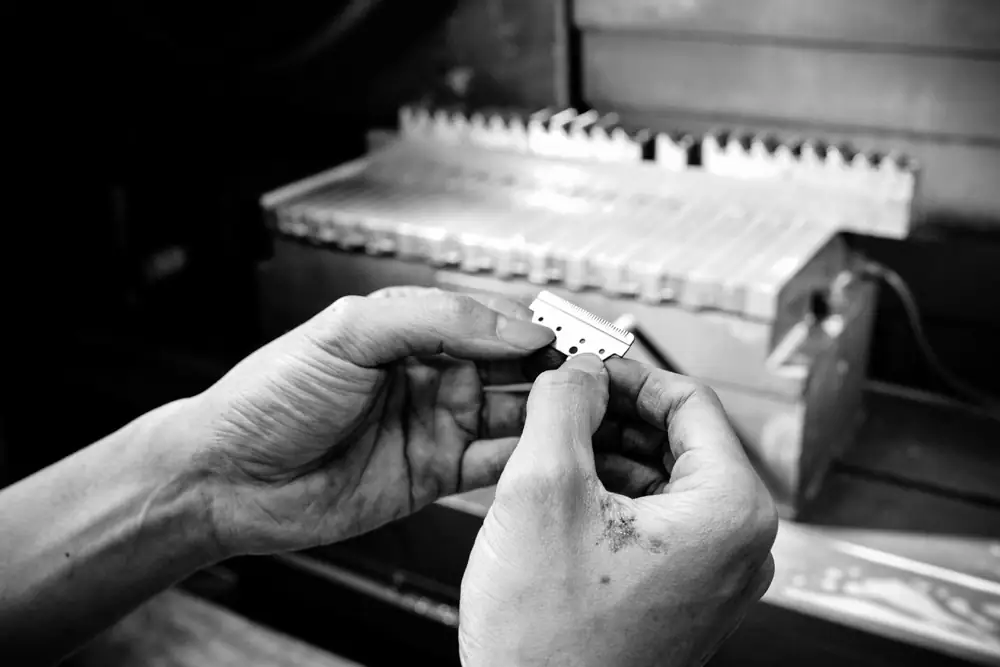
- Quality process, not quality promises. At KUNNEX, every blade is hand-checked after grinding, blade pairs are matched rather than randomly assembled, cutting performance is verified batch by batch, and finished units pass optical inspection before packing. Ask any prospective partner to describe their equivalent process step by step.
- Auditability. An ISO 9001 certified factory that welcomes audits and third-party inspections is making a verifiable claim. A factory that discourages visits is also telling you something.
- Honest cost framing. KUNNEX is rarely the lowest quote — low-cost supply chains can quote roughly half the unit price. The relevant comparison is total cost of quality: returns, negative reviews, marketplace delisting, and chargebacks all land on your brand, not the factory’s. A supplier who raises this openly is negotiating in good faith.
Can You Move Between Models Over Time?
Yes, and the strongest brands usually do. A common trajectory is to launch with private label to validate demand and build review history, shift the best-selling model to an ODM adaptation for differentiation once volume justifies it, and eventually commission OEM development when the brand’s equity supports a proprietary design. Working with one manufacturing partner across those stages compounds the benefit: the factory already knows your quality expectations, your markets, and your certification footprint. For a practical walkthrough of the first stage, see our step-by-step guide on how to start a private label grooming brand, and for the numbers behind it, the full cost breakdown of launching a private label trimmer.
KUNNEX has manufactured electric grooming devices in Taiwan since 1977, serving 100+ international B2B clients in more than 20 countries. Whether your project is private label, ODM, or OEM, inquiries to our team are answered in English, Japanese, or Mandarin within two business days.
Working on a grooming product? KUNNEX private-labels proven platforms and builds OEM programs from its ISO 9001 factory in Taiwan — samples in 7–14 days.
Talk to the factory