
Learning how to start a private label grooming brand in 2026 is less about finding a factory and more about sequencing a series of decisions correctly: which market, which product, which manufacturing partner, which certifications, and how much stock to commit to before you have your first review. Done in the right order, the whole journey — from first inquiry to sellable inventory — typically takes about three months on an existing product platform. Done in the wrong order, brands burn months and five-figure budgets re-certifying products, re-shooting packaging, or clearing stock that the market never wanted. This guide lays out the sequence step by step, based on KUNNEX’s experience manufacturing private label grooming devices in Taiwan for 100+ international B2B clients across more than 20 countries.
Step 1: Which Grooming Niche Should You Enter First?
The grooming device category is broad — nose trimmers, beard trimmers, hair clippers, body groomers, foil shavers, pet clippers — and the honest answer is that a first-time brand should enter one niche, not five. Three criteria narrow the choice.
- Review sensitivity. Products used on the face reward reliability disproportionately. A nose trimmer that pulls hair instead of cutting it earns a one-star review within days. If you can source genuinely well-made blades, review-sensitive niches are where quality manufacturing converts directly into ranking.
- Price-point fit. Battery-operated single-function devices suit entry price points; rechargeable multifunctional kits and barber-grade clippers support premium positioning. Decide where your brand will live before choosing hardware.
- Logistics reality. Lightweight devices — a 22 g pen-type nose trimmer or a 47 g pocket shaver — keep air freight viable for replenishment, which matters enormously in your first year when demand forecasting is guesswork.
A practical opening move for many brands is a giftable multifunction set such as a 3-in-1 kit with nose, beard, and eyebrow heads in retail gift-box format — one SKU that covers several use cases and seasons well in Q4.
Step 2: How Do You Choose the Right Manufacturing Partner?
Anyone researching how to start a private label grooming brand quickly discovers that quotes vary widely — and that the lowest quote is rarely explained. Low-cost supply chains can quote roughly half the unit price of a quality-focused factory. The difference is not margin greed; it is what happens inside the factory. Questions worth asking every candidate:
- Are blade heads, motors, and battery systems designed and made in-house, or bought in from third parties?
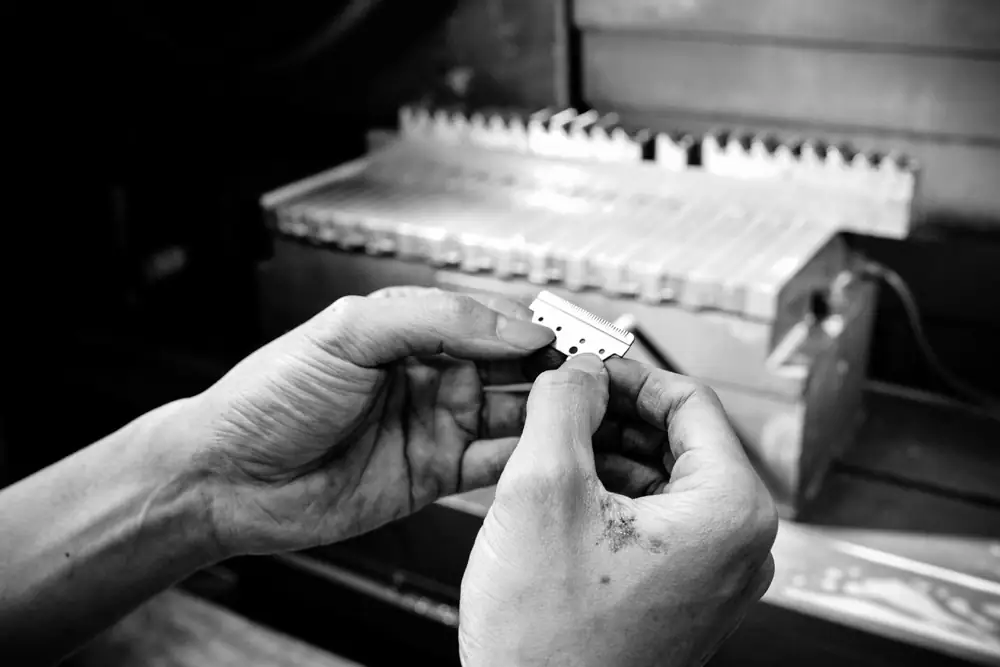
- What happens to a blade after grinding? At KUNNEX, every blade is hand-checked after grinding and blade pairs are matched rather than randomly assembled — because blade pairing is what determines whether a trimmer cuts or pulls.
- Is cutting performance verified batch by batch, and is there optical inspection before packing?
- Is the factory ISO 9001 certified, and does it welcome factory audits and third-party inspections?
- What is the factory’s own track record under pressure? KUNNEX spent 30+ years as an OEM partner to internationally recognized brands whose tolerance for customer complaints was effectively zero — a discipline that now underwrites every private label run.
Weigh answers against total cost of quality, not unit price. Returns, negative reviews, marketplace delisting, and chargebacks are all costs the cheap quote quietly transfers to your brand. For a deeper comparison of supply-chain philosophies, see Taiwan vs. China manufacturing: what you actually pay for.
Step 3: Select a Platform and Define Your Customization
Private label works because the engineering is already done. Your task is to choose a proven platform and make it unmistakably yours. Typical customization options include:
- Logo printing or engraving on the housing
- Custom housing colors matched to your brand palette
- Retail gift-box packaging designed around your identity
- Manuals in your customers’ languages
- Comb and accessory combinations tuned to your market
- Custom blade-head combinations on multifunctional platforms
Platform choice should follow your positioning work from Step 1. A premium men’s brand might build on a machined-aluminum pen-type nose trimmer; a value-focused Amazon brand might start with a waterproof washable model with a water-suction cleaning function as a differentiating talking point; a barber-oriented brand might anchor on a ceramic-blade clipper whose working blade runs roughly 70% cooler than steel. The full program — platforms, options, and process — is outlined on our private label page.
Step 4: Which Certifications Does Your Market Require?
Certification is market-specific and non-negotiable: CE and RoHS for the EU, PSE for Japan, FCC for the US — applied per target market and confirmed per model, with additional certifications arranged where a retailer or marketplace demands them. Two planning rules keep this step painless. First, name every launch market before production starts, because adding a market later can mean re-testing. Second, confirm certification scope in writing per model, not per brand. On established platforms much of the groundwork exists already, which is one reason private label timelines are measured in weeks rather than quarters.
Step 5: Samples, Order, and the Three-Month Timeline
With platform and markets fixed, the execution phase is straightforward and fast on existing platforms.
| Phase | Typical duration | What happens |
|---|---|---|
| Samples | 7–14 days | Samples of existing platforms shipped for evaluation |
| Customization lock | Runs in parallel | Logo, colors, packaging, manuals, accessory mix confirmed |
| Mass production | 45–60 days after order confirmation | Production, batch-by-batch cutting verification, optical inspection |
| Inquiry to sellable stock | About three months | Typical end-to-end for most private label projects |
Minimum order quantities typically run 1,000–3,000 units per model, confirmed per project. For a first order, resist the temptation to negotiate volume discounts on a large initial commitment; a right-sized first run that sells through cleanly teaches you more than a warehouse of stock ever will. Budget expectations for the whole launch — units, packaging, certification, freight — are itemized in our private label trimmer cost breakdown.
Step 6: How Do You Protect Your Brand After Launch?
Manufacturing quality is your review moat, but three post-launch practices determine whether the moat holds.
Inspect independently, even with a trusted partner
KUNNEX welcomes factory audits and third-party inspections, and serious buyers should use them. Independent inspection is not a sign of distrust; it is a sign of a professional supply chain, and it gives your team documented evidence if a marketplace ever questions your product.
Watch reviews as quality telemetry
Marketplace reviews are the fastest early-warning system you will ever get. KUNNEX runs its own consumer brand, URBANER, on Amazon US and Amazon Japan precisely because operating under marketplace scrutiny keeps factory standards honest. Route recurring review themes back to your manufacturer — a good partner treats them as engineering input.
Plan replenishment before you need it
With mass production at 45–60 days after order confirmation plus transit, your reorder point arrives sooner than most first-time brands expect. Model it before launch day, not after your first stockout.

Where Should You Start?
Starting a private label grooming brand in 2026 rewards focus: one niche, one proven platform, one manufacturing partner whose quality process you have verified, and a first order sized for learning. KUNNEX has manufactured electric grooming devices in Taiwan since 1977 — ISO 9001 certified, MIT Smile Mark verified, with products sold in more than 20 countries across four continents. If you are weighing whether private label is even the right model for you, our comparison of private label vs. OEM vs. ODM is the place to begin. When you are ready to discuss a project, contact us — inquiries are answered in English, Japanese, or Mandarin within two business days.
Working on a grooming product? KUNNEX private-labels proven platforms and builds OEM programs from its ISO 9001 factory in Taiwan — samples in 7–14 days.
Talk to the factory