
Ask five factories for a quote and you will get five numbers that are impossible to compare — because unit price is only one line in the real budget. A realistic private label trimmer cost model has seven or eight lines, and the ones buyers forget are usually the ones that hurt: certification scope, packaging tooling, freight, and the quiet, compounding cost of quality failures after launch. This article breaks the budget into its components, explains what drives each one, and shows why the cheapest quote is frequently the most expensive decision in the spreadsheet. It draws on KUNNEX’s 49 years of manufacturing electric grooming devices in Taiwan and on typical commercial terms — every figure below is indicative and confirmed per project at quotation.
What Are the Main Components of Private Label Trimmer Cost?
Every private label launch budget reduces to the same structure. The proportions shift with product class and market, but the lines do not.
| Budget line | What drives it | One-time or recurring |
|---|---|---|
| Unit cost × order quantity | Platform, blade material, motor, battery system, waterproof rating; MOQ typically 1,000–3,000 units per model | Recurring — the largest line |
| Customization | Logo printing or engraving, custom housing colors, accessory and comb combinations | Mostly one-time setup, small per-unit element |
| Packaging | Retail gift-box design and printing, manuals in your customers’ languages | Design one-time; print cost recurring |
| Certification | CE and RoHS (EU), PSE (Japan), FCC (US) — applied per target market, confirmed per model | One-time per model per market |
| Samples and evaluation | Samples of existing platforms in 7–14 days | One-time, minor |
| Freight and duties | Product weight, sea vs. air, destination tariffs | Recurring |
| Inspection | Optional third-party pre-shipment inspection — welcomed at KUNNEX | Recurring, small |
| Cost of quality failures | Returns, negative reviews, delisting, chargebacks | Recurring — and controllable at the factory stage |
How Does Unit Price Really Behave — and Why Do Quotes Differ by Half?
The dominant line in any private label trimmer cost model is unit price multiplied by order quantity, so it deserves the most scrutiny. Unit price is built from real engineering choices: a Japan high-carbon steel or Sandvik Sweden stainless blade versus a generic one, a Japanese MABUCHI motor versus an unbranded equivalent, a genuinely sealed IPX8 waterproof construction versus a splash-resistant claim, USB Type-C recharging versus disposable batteries. Each choice moves the number, and each one is visible to your end customer within weeks of launch.
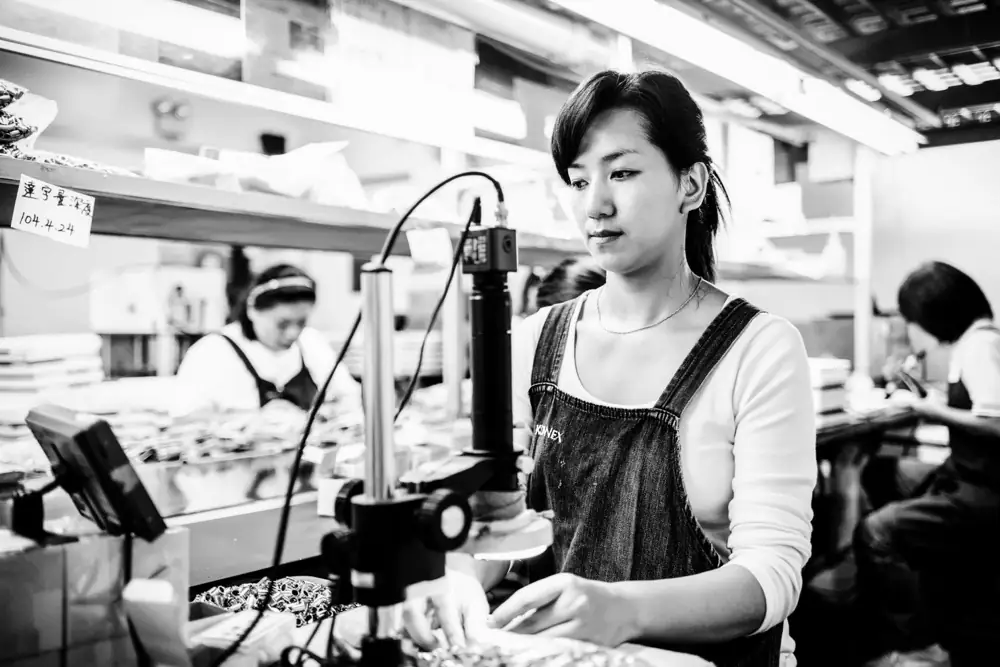
It also explains the spread between quotes. Low-cost supply chains can quote roughly half the unit price a quality-focused factory quotes for what looks, on a spec sheet, like the same trimmer. KUNNEX is rarely the lowest quote, and we say so openly. What the lower number typically omits is process: at our factory every blade is hand-checked after grinding, blade pairs are matched rather than randomly assembled, cutting performance is verified batch by batch, and units pass optical inspection before packing. None of that is free, and all of it determines whether your product cuts cleanly on unit 4,000 the way it did on the sample.
How MOQ shapes the first purchase order
With MOQs typically at 1,000–3,000 units per model, your first purchase order is the single biggest check you will write. Two planning rules help. First, size the first order for learning, not for maximum volume discount — sell-through data from a right-sized first run is worth more than a marginal unit-price saving on stock you may discount later. Second, remember that per-unit pricing improves with volume on reorders, when your demand curve is real rather than forecast.
Which Costs Do First-Time Buyers Most Often Forget?
Certification, per model and per market
Compliance is not a brand-level formality — it attaches to a specific model in a specific market. CE and RoHS for the EU, PSE for Japan, FCC for the US, each applied per target market and confirmed per model, with additional certifications arranged where a channel requires them. Budget this line per launch market, and fix your market list before production; adding a region afterward can mean re-testing. On established platforms much of the groundwork already exists, which materially lowers this line compared with a new design.
Packaging is a product, too
Retail gift-box packaging carries design cost, print setup, and a per-unit print price — and for giftable grooming kits the box does real selling work on shelf and in marketplace images. Manuals in your customers’ languages are part of the same line and part of compliance in several markets.
Freight follows physics
Grooming devices are light — a pen-type trimmer weighs 22 g, a pocket shaver 47 g, even a barber-grade clipper 149 g — which keeps air freight a realistic option for launch stock and replenishment. Heavier gift sets in rigid boxes shift the calculation toward sea freight and longer lead planning.
The line that never appears on the quote
Cost of quality failure is the omitted variable that reorders every comparison. A batch with mismatched blades produces pulling instead of cutting; pulling produces one-star reviews; reviews suppress ranking; enough of them produce returns, chargebacks, and in the worst case delisting. Every one of those costs lands on your brand, not the factory that saved you the money. This is the total-cost-of-quality argument in one sentence: the difference between two quotes is small compared to the cost of the cheaper one failing.
What Does the Timeline Mean for Cash Flow?
Cost and cash flow are different problems. The typical private label sequence — samples of existing platforms in 7–14 days, mass production in 45–60 days after order confirmation, about three months from inquiry to sellable stock — means your capital is committed for a full quarter before revenue begins. Three practical consequences follow.
- Deposit and balance payments should be mapped against your other launch spending — photography, listing creation, launch advertising — so they do not collide in the same month.
- Your reorder decision arrives early. With 45–60 day production plus transit, a launch that sells well forces a replenishment order before the first order has fully paid for itself. Model this before launch.
- Third-party pre-shipment inspection, which KUNNEX welcomes, is cheap insurance on the largest check in the budget and should be treated as a standing line, not an extra.
How Do You Keep the Total Down Without Cutting Quality?
There are legitimate ways to reduce a launch budget, and none of them involve accepting unverified blades.
- Launch on an existing platform. Tooling is the expensive part of hardware; a proven platform makes it someone else’s sunk cost. The options — from single-function nose trimmers to multifunctional kits with custom blade-head combinations — are described on our private label page.
- Start with one model and one or two markets. Every added market adds certification scope; every added model adds MOQ commitment.
- Use stock housing colors for the first run. Custom colors are a strong second-order differentiator once sell-through is proven.
- Choose the platform tier deliberately. A battery-operated entry clipper and a rechargeable ceramic-blade barber clipper serve different price points; matching platform to positioning avoids paying for capability your customer will not pay you for.
For the decision that precedes all of this — whether private label is the right model at all — see private label vs. OEM vs. ODM, and for the launch sequence itself, our guide on how to start a private label grooming brand.
KUNNEX has manufactured electric grooming devices in Taiwan since 1977 — ISO 9001 certified, with 30+ years as OEM partner to brands whose tolerance for complaints was effectively zero. For a project-specific quotation across all the lines above, contact our team; inquiries are answered in English, Japanese, or Mandarin within two business days.
Working on a grooming product? KUNNEX private-labels proven platforms and builds OEM programs from its ISO 9001 factory in Taiwan — samples in 7–14 days.
Talk to the factory