
A custom logo trimmer is where a sourcing project becomes a brand. Up to that point, the buyer and the factory have been discussing blades, motors, and certifications—necessary, but generic. The moment a logo goes onto the housing, the product stops being a commodity SKU and starts carrying reputation, and the technical choices behind that logo suddenly matter more than most buyers expect. Printing and engraving age differently, read differently on camera, and behave differently on a device that lives in a wet bathroom and gets handled daily. This guide compares the branding options an established grooming-device factory can execute on a custom logo trimmer—printing, laser engraving, housing colors, and packaging—and explains which combination fits which kind of brand.
What branding options exist for a custom logo trimmer?
Within a structured private label program, branding is applied in layers. Each layer is a separate decision with its own cost, durability, and design implications.
- Logo printing — ink applied to the housing, capable of reproducing multi-color marks and fine lockups.
- Logo engraving — the mark is inscribed into the housing surface, permanent by nature and tone-on-tone in appearance.
- Custom housing colors — the device itself becomes the brand asset, beyond stock options.
- Retail gift-box packaging — fully branded outer packaging designed for shelf or unboxing.
- Manuals in customer languages — often overlooked, but the first owned media a customer reads.
- Comb and accessory combinations — configuring the in-box contents to differentiate the offer itself.
These are the standard customization levers in the KUNNEX private label program, applied to platform models that are already engineered, tooled, and proven in production. That matters because branding quality is downstream of manufacturing quality: crisp printing needs consistent housing surfaces, and clean engraving needs process control. Both come from the same discipline that has an ISO 9001 certified factory hand-checking every blade after grinding.
Printing or engraving—which suits your custom logo trimmer?
This is the decision buyers spend the most time on, and the right answer depends on the logo itself, the product environment, and the brand’s visual language.
What printing does well
Printing reproduces the logo as designed: brand colors, gradients within reason, fine typography, and multi-element lockups. On a dark housing, a printed white or metallic mark delivers strong shelf and thumbnail contrast—a real consideration when the product will be judged as a 100-pixel image on a marketplace search page. Printing is applied per unit during production and is generally the economical route at typical MOQs of 1,000–3,000 units.
Its limitation is mechanical. A printed mark sits on the surface of a device that is gripped in wet hands, rinsed under taps, and carried in wash bags. Print durability on a well-prepared housing is good, but over years of heavy use, surface wear is a possibility that a premium brand should weigh.
What engraving does well
Engraving inscribes the mark into the housing, so it cannot peel, fade, or rub off—the logo lasts as long as the device. The result reads as tone-on-tone: subtle, premium, closer to what buyers associate with high-end razors and Japanese-style minimalism. On metal housings the effect is strongest; the MB-051 pen-type nose trimmer, with its aluminum case, takes engraving particularly well and is a common choice for brands positioning at the elegant end of the category.
Engraving’s trade-off is chromatic: it renders the mark in the material’s own tones, so a brand whose identity depends on exact color reproduction will not get its palette from engraving alone. Very fine multi-color lockups also simplify to a single-tone mark.
Side-by-side comparison
| Factor | Logo printing | Logo engraving |
|---|---|---|
| Color reproduction | Full brand colors, multi-color marks | Tone-on-tone, single tone |
| Durability | Good on prepared surfaces; can wear over years of heavy use | Permanent for the life of the device |
| Perceived positioning | Retail, contemporary, high visibility | Premium, understated, gift-appropriate |
| Best surfaces | Most housing materials and colors | Strongest on metal, e.g. aluminum cases |
| Marketplace thumbnail impact | High contrast, reads at small sizes | Subtle; relies on product design to carry the image |
| Typical use case | Amazon-first brands, bold identities | Premium D2C, corporate gifting, minimalist brands |
A useful heuristic: if your buyer meets the product first as a thumbnail, lean printed; if your buyer meets it first in the hand—gifting, subscription boxes, premium retail—lean engraved. Some brands do both across a range, printing the accessible line and engraving the flagship.
How far beyond the logo should branding go?
Housing colors
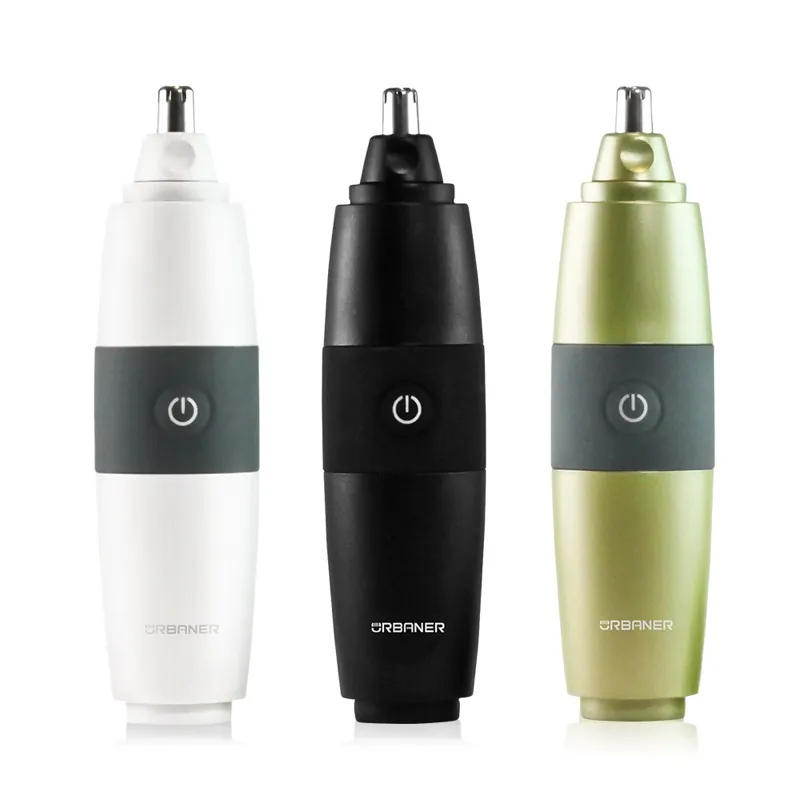
Stock colors exist for speed—the MB-061 premium ear and nose trimmer, for instance, ships in white, black, or champagne—and for many launches a stock color plus a well-executed logo is the right scope. Custom housing colors move the brand into the product itself, turning the device into something recognizable without reading the logo at all. They involve additional coordination and are confirmed per project, which is one more reason the typical three-month path from inquiry to sellable stock benefits from early decisions.
Packaging and unboxing
Retail gift-box packaging is where grooming brands win Q4. A device like the MB-980 3-in-1 kit is built around a gift-box format precisely because a large share of grooming purchases are gifts—the box is not protection, it is the product’s first impression. Custom packaging also carries the compliance layer: marks and information required by CE and RoHS in the EU, PSE in Japan, or FCC in the US, applied per target market and confirmed per model.
Manuals and in-box contents
Manuals in the customer’s language reduce confusion-driven returns and support requests, and they are a branding surface in their own right. Comb and accessory combinations—and on multifunctional platforms, the blade-head combination itself—let two brands build genuinely different offers on the same proven engineering base.
What should you confirm with the factory before branding?
Branding decisions fail in execution, not in concept, so put the execution questions to the factory early.
- Request branded samples, not just renders. Approve the actual printed or engraved mark on the actual housing material before mass production. Samples of existing platforms typically ship in 7–14 days.
- Confirm placement and sizing against the tooling. Curved housings, waterproof seams, and grip textures constrain where a mark can sit; the factory’s engineers know these constraints because they designed the tooling. In-house control of design, tooling, and mass production—the scope described on the KUNNEX contract manufacturing page—is what makes this conversation fast.
- Get the branding specification into the purchase order—method, position, dimensions, colors—so every batch matches the approved sample. Optical inspection before packing is the process step that enforces it.
- Sequence decisions with the timeline. Logo method and placement are early decisions; packaging artwork can run in parallel with production preparation. Mass production typically takes 45–60 days after order confirmation.
One more structural point: branding scope is part of what distinguishes a private label project from deeper OEM work. If you are weighing how much customization your first product actually needs, our guide to private label, OEM, and ODM maps the options to budget and timeline.
A logo on a trimmer is a small surface carrying a large promise. Execute it with a factory that has been putting other brands’ names on its devices for more than 30 years—under clients whose tolerance for complaints was effectively zero—and the smallest branding detail will hold up as well as the blades behind it. KUNNEX answers branding and platform inquiries at sales@kunnex.com in English, Japanese, or Mandarin within 2 business days.
Working on a grooming product? KUNNEX private-labels proven platforms and builds OEM programs from its ISO 9001 factory in Taiwan — samples in 7–14 days.
Talk to the factory