
Most buyers open a sourcing beard trimmers guide looking for a price target and close it with a supplier shortlist. That order is backwards. In this category, the unit price is the least informative number on the quotation, because two trimmers that look identical on a spec sheet can behave completely differently after ninety days in a customer’s bathroom. The differences live in blade steel, motor sourcing, battery architecture, and the quality-control discipline of the factory behind them. This guide walks through the specifications that actually predict review scores and return rates, drawing on KUNNEX’s 49 years of electric grooming device manufacturing in Taiwan and more than 30 years as an OEM partner to internationally recognized brands whose tolerance for customer complaints was effectively zero.
Why does blade steel decide so much when sourcing beard trimmers?
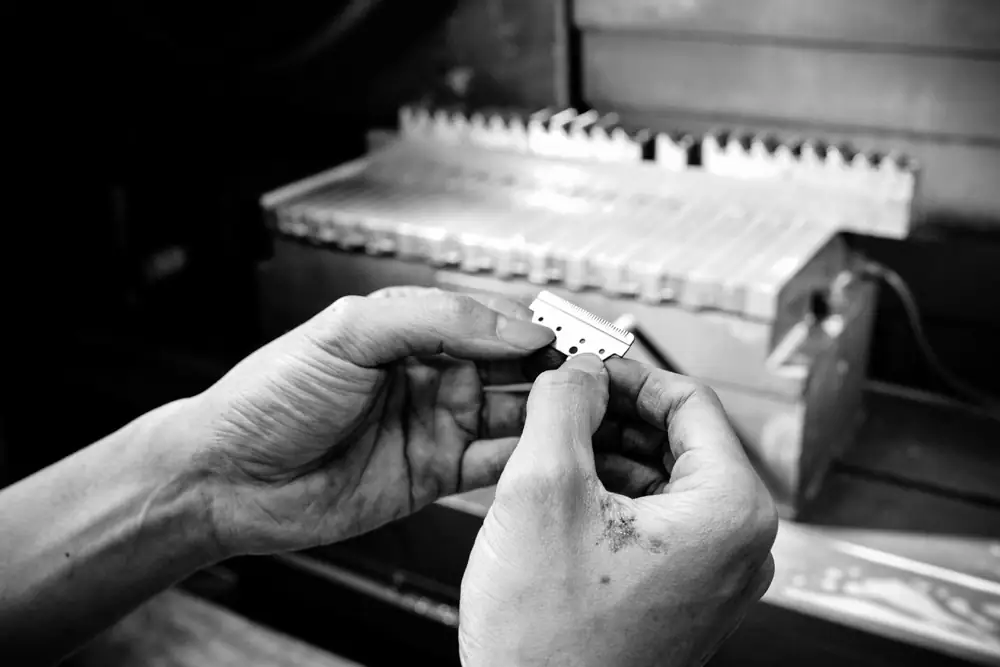
A beard trimmer is, mechanically, a pair of toothed blades reciprocating against each other several thousand times per minute. Everything the end customer feels — pulling, snagging, skin irritation, heat — traces back to how well those two blades were ground, matched, and assembled.
Ask any prospective supplier three questions about the blade head:
- What steel, from which mill? Generic answers such as “stainless steel” tell you nothing. KUNNEX specifies the material by line: Japanese high-carbon steel on the MB-342B beard trimmer, Japanese stainless steel on the MB-042 groomer, and Sandvik Sweden stainless steel and ceramic working blades on other platforms. Named steel sources can be verified; vague ones cannot.
- Who grinds the blades? Factories that buy finished blade heads from third parties cannot control edge geometry or fix a tolerance problem mid-production. KUNNEX designs and manufactures blade heads in-house, from tooling through mass production, under one roof.
- How are blade pairs assembled? Randomly pairing upper and lower blades is faster and cheaper. Matching pairs — and hand-checking every blade after grinding, as KUNNEX does — is what keeps cutting performance consistent across a 3,000-unit order rather than only across the golden samples.
What motor and battery specifications should buyers compare?
The motor determines torque consistency through dense beard hair, and it is one of the most common places for low-cost suppliers to economize invisibly. A weak or inconsistent motor does not fail on day one; it slows under load, the blade pulls instead of cutting, and the product earns two-star reviews around month three. KUNNEX builds its trimmer platforms around Japanese MABUCHI motors precisely because motor consistency is not something you can inspect into a finished unit.
On power architecture, the market has settled into two valid approaches, and the right one depends on your channel:
- AA battery platforms, such as the MB-042 wet and dry groomer (one AA cell, roughly 90 minutes of runtime, 55 g), suit travel retail, pharmacy, and gift channels where customers value grab-and-go simplicity and no charging cables.
- USB rechargeable platforms, such as the MB-342B with USB Type-C, suit e-commerce and premium retail where customers expect the same connector as their phone. Type-C specifically is worth insisting on; micro-USB reads as dated in reviews.
Whichever architecture you choose, ask the factory to document runtime per charge or per cell under load, not free-running. The numbers differ, and only the loaded figure reflects real use.
How should a sourcing beard trimmers guide treat waterproofing and comb ranges?
Waterproofing claims are a frequent source of listing trouble. “Washable head” means the blade assembly tolerates rinsing; a whole-piece waterproof or IPX8-rated body means the entire device can go under the tap or into the shower. (IPX8 is the ingress-protection rating for sustained immersion.) If your listing will say “waterproof,” the certification and construction need to back the word, because marketplace compliance teams and litigious competitors both read listings closely.
Comb range is the second quiet differentiator. A beard trimmer that cannot produce the stubble lengths customers actually want — typically the 2–6 mm zone — will disappoint regardless of build quality. Compare two current KUNNEX platforms:
| Specification | MB-342B Waterproof Rechargeable Beard Trimmer | MB-042 Wet & Dry Beard/Mustache Groomer |
|---|---|---|
| Blade steel | Japan high-carbon steel | Japan stainless steel |
| Motor | Japanese MABUCHI | — |
| Power | USB Type-C rechargeable | AA × 1, approx. 90 min |
| Water protection | IPX8 | Whole-piece waterproof |
| Cutting heads | Dual heads (wide + detail) | Single head |
| Combs | 3/4/5/6 mm | 2–14 mm |
| Weight | — | 55 g |
Neither platform is “better”; they serve different positioning. The dual-head MB-342B supports a premium detail-trimming story, while the MB-042’s wide comb range and light weight fit a value-focused all-rounder. The full line is documented on our beard trimmer manufacturing page.
What should a sourcing beard trimmers guide say about certifications and commercial terms?
Certification requirements follow the destination market, and a serious supplier will confirm scope per model rather than waving at a folder of certificates. The typical map: CE and RoHS for the EU, FCC for the US, PSE for Japan. KUNNEX applies these per target market, confirms them per model, and can arrange additional certifications where a channel requires them. Retailer-specific documentation — test reports tied to your actual SKU, not a cousin model — is worth requesting in writing before you commit tooling or packaging spend.
On commercial terms, realistic industry framing helps you spot outliers in both directions. At KUNNEX, minimum order quantities typically run 1,000–3,000 units per model, samples of existing platforms ship in 7–14 days, and mass production typically takes 45–60 days after order confirmation. Most private label projects go from first inquiry to sellable stock in about three months. A supplier quoting dramatically faster timelines is usually skipping steps — often the inspection steps. For a fuller breakdown of where the money goes in a trimmer quotation, see our private label trimmer cost breakdown.
How do you evaluate the factory behind the spec sheet?
Specifications describe the product; they do not describe the probability that unit 2,847 matches unit 12. That probability is set by process discipline, and it is the reason factory evaluation belongs in any sourcing beard trimmers guide worth following. Concrete things to verify:
- In-house scope. Does the factory design and build blade heads, motors, and battery systems itself, or assemble bought-in modules? In-house scope means problems get fixed at the source instead of negotiated with sub-suppliers.
- Inspection regime. KUNNEX hand-checks every blade after grinding, verifies cutting performance batch by batch, and runs optical inspection before packing. Ask any candidate supplier to describe their equivalent steps — specifically, not generally.
- Audit posture. A factory that welcomes audits and third-party inspections, as KUNNEX does, is telling you its processes survive daylight. Hesitation here is data.
- Track record with demanding clients. Decades of OEM work for brands with near-zero complaint tolerance is a different signal than decades of selling unbranded stock. KUNNEX is ISO 9001 certified, MIT Smile Mark certified (verified by Taiwan’s Ministry of Economic Affairs), and serves 100+ international B2B clients across 20+ countries.
The honest caveat: a factory that operates this way is rarely the lowest quote. Low-cost supply chains can come in at roughly half the unit price. The arithmetic that matters is total cost of quality — returns, refunds, review damage, chargebacks, and in the worst case a delisted ASIN — which is where the cheaper unit routinely becomes the more expensive decision. Our contract manufacturing capabilities page details the processes behind these claims, and our engineering team responds to inquiries at sales@kunnex.com in English, Japanese, or Mandarin within two business days.
Where should a buyer start?
Start with samples, not slide decks. Request two or three platforms that bracket your target positioning, put them through a month of real shaving, and only then discuss pricing. A supplier confident in its blades will encourage exactly this sequence. When you are ready to compare platforms against your channel requirements, the specifications above — named blade steel, documented motor sourcing, loaded runtime, verified waterproof rating, and a comb range that matches how customers actually trim — will tell you more than any price list.
Working on a grooming product? KUNNEX private-labels proven platforms and builds OEM programs from its ISO 9001 factory in Taiwan — samples in 7–14 days.
Talk to the factory