
In most grooming categories, a mediocre blade produces a mediocre review. In the lady shaver category, it produces a one-star review with a photograph. Devices designed for legs, underarms, and the bikini line meet thinner, more sensitive skin over bonier and more contoured anatomy than a beard trimmer ever faces, so nicks, razor burn, and irritation are punished immediately and publicly. For a brand, this means the choice of lady shaver manufacturer is not a procurement detail; it is the product decision. This article looks at what “skin-safe” actually means in blade engineering, how a factory builds safety into a blade rather than inspecting for it afterwards, and what buyers should verify before putting their name on a device that touches sensitive skin.
What makes a blade skin-safe?
“Skin-safe” is not a material or a coating; it is the sum of several engineering decisions that determine whether hair enters the cutting zone while skin stays out of it:
- Edge geometry. The grind angle and finish of each blade edge decide whether hair is sliced cleanly or pushed and pulled. A poorly finished edge does not cut less — it cuts unpredictably, which on sensitive skin reads as burning and redness.
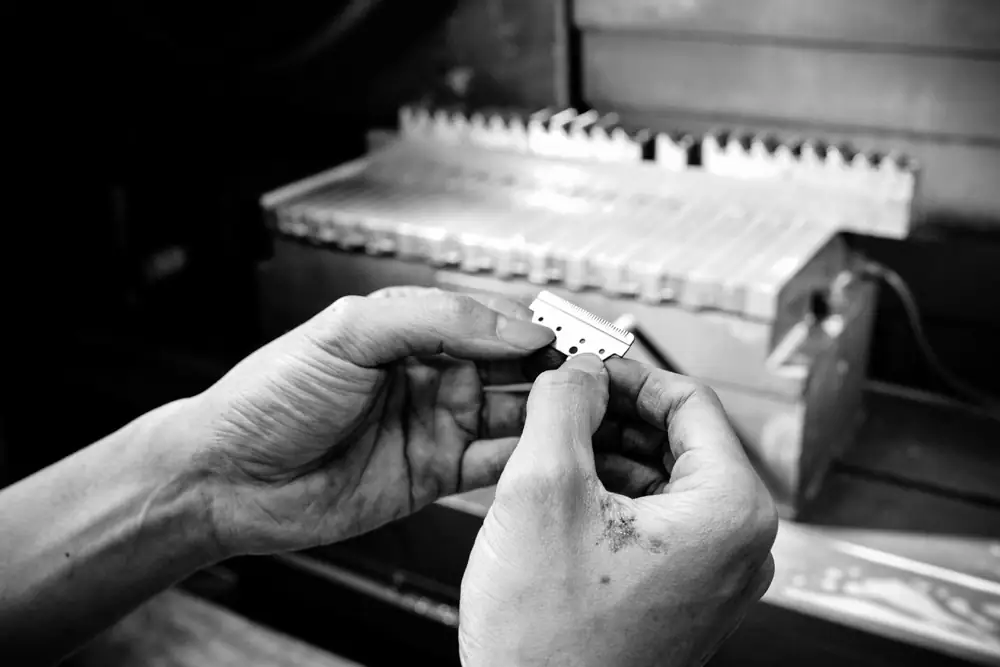
- Blade-pair matching. A trimmer head is two toothed blades working as a pair. If the pair is assembled from randomly selected parts, gaps vary tooth by tooth, and variable gaps are where skin gets pinched. At KUNNEX, blade pairs are matched, not randomly assembled, and every blade is hand-checked after grinding.
- Guard and foil design. The perforated foil or comb guard is the physical barrier between edge and skin. Its hole geometry, edge rounding, and stiffness have to admit fine body hair while excluding skin that flexes into the head under pressure — a harder problem on contoured areas than on a flat cheek.
- Heat management. Friction heat builds during longer body-grooming sessions. A blade that runs hot forces the user to stop, or worse, to continue. Material choice (more on this below) and precise blade-to-blade fit both control heat at the source.
None of these attributes appears on a typical quotation sheet, which is why two “identical” lady shavers can differ so sharply in returns.
How does a lady shaver manufacturer engineer for sensitive skin?
The honest answer is: upstream, or not at all. Once a blade head arrives as a purchased module, an assembler can test it but cannot improve it. A manufacturer that designs and grinds its own blades can attack skin-comfort problems at each stage of production:
- Material selection. KUNNEX works with a defined set of blade materials across its lines — Sandvik Sweden stainless steel, Japanese high-carbon steel, Japanese stainless steel, and ceramic working blades that generate roughly 70 percent less heat. For wet-use body devices, corrosion-resistant stainless steel matters doubly, because a blade that degrades in a humid bathroom loses exactly the edge quality that made it skin-safe.
- In-house grinding and tooling. Blade heads, motors, and battery systems are designed and manufactured in-house, from R&D and tooling to mass production, under one roof. When an edge-finish issue appears, it is corrected at the grinding machine, not negotiated with a sub-supplier three weeks later.
- Verification at production scale. Cutting performance is verified batch by batch, and units pass optical inspection before packing. For a skin-contact device, this is the difference between “the samples were fine” and “unit 2,900 is fine.”
- Motor consistency. Blade speed stability affects cutting smoothness on fine body hair. KUNNEX builds on Japanese MABUCHI motors, keeping stroke behavior consistent across a production run.
This discipline was not developed for the lady shaver category specifically. It comes from 30+ years as an OEM manufacturing partner to internationally recognized brands whose tolerance for customer complaints was effectively zero — a constraint that shapes every process a factory keeps.
Why do wet use and washability matter more in this category?
Body grooming happens overwhelmingly in the shower or bath. That fact drives three requirements buyers should treat as non-negotiable:
- Genuine waterproof construction, not merely a rinseable head. Whole-piece waterproof or fully washable construction lets users clean the device properly, and hygiene is a repeat theme in reviews of body-grooming products.
- Corrosion-resistant blade steel. A blade that lives wet must stay smooth. This is where a named material such as Sandvik stainless steel earns its place on the spec sheet.
- Housing ergonomics for wet hands. Grip security is a safety feature when the device is used on contoured areas with soap in the picture.
KUNNEX’s current platform for this segment is the MB-333B Washable Body Shaver & Trimmer: Sandvik steel blades, a Japanese MABUCHI motor, USB rechargeable operation with roughly 90 minutes of runtime, fully washable construction, and comb settings from 1 to 18 mm across eight positions — a range wide enough to cover everything from close body shaving to length-managed trimming on a single device. The full line for this category is on our lady shaver manufacturing page.
What should buyers ask a lady shaver manufacturer before committing?
A short, pointed question list separates factories that engineer for skin comfort from factories that assemble around it:
| Question | What a strong answer sounds like |
|---|---|
| Who grinds your blades, and where? | In-house, on our own machines, with our own tooling — and you are welcome to audit the line. |
| How are blade pairs assembled? | Matched pairs, hand-checked after grinding — never random assembly from parts bins. |
| What exactly is the blade material? | A named, verifiable source: Sandvik Sweden stainless steel, Japanese stainless or high-carbon steel, or ceramic. |
| How is cutting performance verified in mass production? | Batch-by-batch cutting verification plus optical inspection before packing, documented per order. |
| Which certifications apply to my markets? | CE and RoHS for the EU, FCC for the US, PSE for Japan — applied per target market and confirmed per model. |
Add the commercial basics: at KUNNEX, MOQs typically run 1,000–3,000 units per model, samples of existing platforms ship in 7–14 days, and mass production typically takes 45–60 days after order confirmation. Most private label projects reach sellable stock in about three months, with customization covering logo printing or engraving, custom housing colors, retail gift-box packaging, and manuals in your markets’ languages — details on the private label program page. If you are still deciding how much of the product definition to own yourself, the distinctions are laid out in private label vs OEM vs ODM.
How should you weigh price against skin-safety risk?
KUNNEX is rarely the lowest quote in this category; low-cost supply chains can offer roughly half the unit price. For some products, that arithmetic is tempting. For a device marketed to sensitive skin, it rarely survives contact with the market, because the categories of failure — nicks, irritation, corroded blades after a month of shower use — convert directly into returns, negative reviews with photographs, chargebacks, and in marketplace channels the risk of delisting. The total cost of quality, not the unit price, is the number that determines whether the SKU makes money in year two.
A practical closing test: put samples through several weeks of real wet-room use before you negotiate a cent. KUNNEX has manufactured electric grooming devices in Taiwan since 1977, is ISO 9001 and MIT Smile Mark certified, and welcomes factory audits and third-party inspections. Inquiries to sales@kunnex.com are answered in English, Japanese, or Mandarin within two business days.
Working on a grooming product? KUNNEX private-labels proven platforms and builds OEM programs from its ISO 9001 factory in Taiwan — samples in 7–14 days.
Talk to the factory