
Ask a professional groomer what makes a clipper good and heat will come up before sharpness does. A blade that warms during a long session makes an animal fidget, shortens the working window before the operator has to stop and cool the head, and in the worst case leaves a mark on the skin. This is why a ceramic blade pet clipper is specified so often at the professional end of the category — not because ceramic is exotic, but because the physics of a ceramic-against-steel blade pair produce roughly 70 percent less heat than a steel-on-steel pair doing the same work. This article explains where that heat comes from, why ceramic reduces it, and what the trade-offs are when you specify it.
The explanation matters commercially, not just technically. “Runs cooler” is a claim any listing can make. Understanding the mechanism is what lets a buyer tell a genuine ceramic system from a marketing line, and lets a brand defend the claim when a marketplace or a professional buyer asks why the device costs more.
Where does the heat in a clipper actually come from?
Three sources contribute, in roughly this order of significance during a long groom.
Friction between the blade pair
A clipper cuts by driving one toothed blade back and forth across a second, stationary one. Those two surfaces are held in firm, continuous contact — they have to be, or hair slips into the gap instead of being sheared. Contact plus motion plus pressure equals friction, and friction converts motor energy directly into heat at the exact surface that rests against the animal. This is the dominant heat source, and it scales with stroke rate and session length.
The work of cutting
Shearing hair takes energy, and a proportion of that energy also ends up as heat. A sharp, correctly paired blade set does this work efficiently. A dull or poorly matched pair does not shear cleanly; it drags, compresses, and tears, which raises both cutting force and the friction load behind it. Blade heat and blade quality are therefore the same problem viewed from two angles.
Motor and drive losses
Motor and linkage inefficiency add heat inside the housing. This affects how warm the body feels in the operator’s hand more than how warm the blade feels against the animal, but a drive under strain from a dragging blade set compounds the problem at both ends.

Why does a ceramic blade pet clipper run cooler?
Ceramic changes the equation in three ways at once, which is why the effect is large rather than marginal.
- Lower friction against steel. A ceramic surface sliding against a steel one has a lower coefficient of friction than steel against steel, and unlike two similar metals it will not micro-weld or gall under pressure. Less friction at the same stroke rate means less energy converted to heat.
- Lower heat conduction into the contact surface. Ceramic conducts heat far less readily than steel. Whatever heat is generated moves more slowly into the surface resting against the animal’s skin, so the perceived temperature at the point of contact stays lower.
- Better edge retention, so less drag develops. Ceramic is extremely hard and holds its edge geometry over long service. Because a dull edge is itself a heat source, an edge that stays keen keeps the device cool for longer rather than warming progressively across a working day.
Ceramic also cannot rust, which matters in a category where blades are washed, sprayed with coolant, and used on damp coats. The usual arrangement is a ceramic working blade running against a steel stationary blade, which is how KUNNEX configures its pet line, including the MB-033 clipper that pairs a Sandvik steel stationary blade with a ceramic working blade.
How do ceramic and steel blade pairs compare in service?
| Property | Ceramic working blade on steel | Steel on steel |
|---|---|---|
| Heat generated in extended use | Roughly 70% less | Baseline |
| Heat transferred to contact surface | Low — ceramic conducts poorly | Higher |
| Edge retention | Very high | Good to high, material dependent |
| Corrosion | Cannot rust | Depends on grade and coating |
| Impact tolerance | Lower — can chip if dropped | Higher — dents rather than chips |
| Blade cost | Premium | Mid to premium |
| Best fit | Long sessions: pet grooming, barber-grade clipping | Short sessions and price-led tiers |
Why does blade heat matter more for animals than for people?
Three reasons, all practical.
First, exposure time. A human clipper session lasts a few minutes on a scalp with hair between the blade and the skin. A full-body groom on a medium dog can run 45 minutes or more, with the blade in close contact throughout, and a professional may run several appointments back to back with the same device.
Second, the animal cannot tell you. A person feels a warm blade and says so. A dog or cat registers discomfort as movement — flinching, twisting, or refusing to settle — which the handler experiences as a difficult animal rather than a warm clipper. The device gets blamed last.
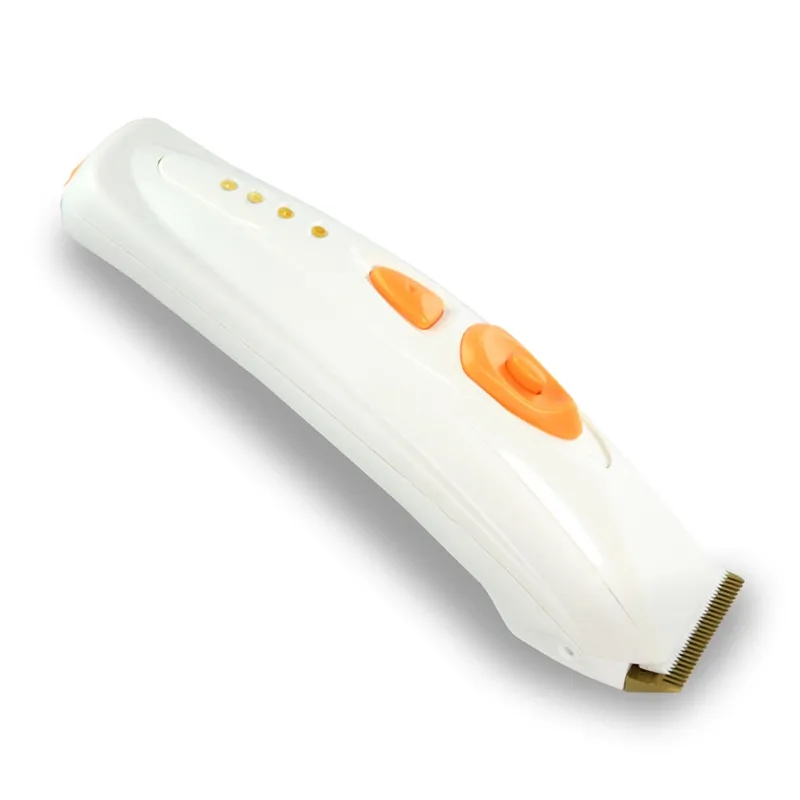
Third, skin contact is closer. Pet clipping frequently works at short settings against loose skin, so the blade surface itself rests on the animal rather than gliding over a layer of hair. The MB-055 full-body clipper, for instance, uses a ceramic safety blade with a built-in five-step dial from 0.2 to 2.5 mm, precisely the range where blade temperature is felt directly.
What are the trade-offs of specifying ceramic?
Ceramic is not a free upgrade, and a supplier who presents it as one is not being straight with you.
- Brittleness. A dropped ceramic blade can chip where a steel blade would dent. In professional environments where clippers are handled all day, this argues for a replaceable blade head and a stocked spares programme rather than against ceramic itself.
- Cost. Ceramic blades sit at the premium end. They earn their place in devices used for long sessions and are difficult to justify in a short-session, price-led device.
- Pairing sensitivity. The 70 percent figure assumes a correctly matched pair in tight, even contact. A ceramic blade assembled at random against a steel blade that is slightly out of flat will drag, heat, and cut poorly — the material cannot compensate for a manufacturing shortcut.
- It does not fix runtime. Cool running lets a groomer work longer; the battery still has to last. A professional specification pairs ceramic with real runtime, such as the 180 minutes on the two-speed MB-066, or a corded fallback for sessions that overrun.
How should you specify a ceramic blade pet clipper?
Four checks separate a genuine ceramic system from a cosmetic one. Ask whether the ceramic working blade runs against a specified steel stationary blade and which grade. Ask whether the blade pair is matched deliberately or assembled from bins — the mechanism depends entirely on contact quality. Ask how cutting performance is verified, batch by batch rather than at first article. And run a sample continuously for a full session length, then check the blade temperature by hand, because that single test tells you more than any datasheet.
KUNNEX grinds, matches, hand-checks, and optically inspects its own blade heads in Taiwan, and designs motors and battery systems in-house alongside them — and supplies those heads as standalone blade modules where a brand only needs the cutting system. The process is set out on the contract manufacturing capabilities page. Ceramic-blade models across the professional and consumer tiers can be reviewed on the pet grooming device line, with the barber-grade human equivalent on the hair clipper page. Samples of existing platforms typically ship in 7–14 days, and enquiries to sales@kunnex.com are answered in English, Japanese, or Mandarin within two business days.
Sending a drawing or a blade specification? We check feasibility against our own grinding and heat-treatment line — and can supply the blade head alone as a designed-in component.
Send a specification Blade module supply