
Every grooming catalog has its headline SKUs — the beard trimmer, the hair clipper, the rotary shaver — and then it has the products buyers skim past. The pocket shaver usually sits in the second group, which is exactly why it deserves a closer look. For travel retail, corporate gifting, and impulse-purchase channels, a credit-card-footprint foil shaver solves problems that full-size devices cannot, at a price point that fits gift budgets and airport shelves. The catch is that miniaturization punishes sloppy engineering, so choosing the right pocket shaver supplier matters more here than in almost any other grooming category. This article explains where the format wins, what the engineering actually involves, and how to qualify a factory before you commit an order.
Why do travel and gift channels reward the pocket shaver format?
Three structural features of these channels favor small-format shavers:
- Physical constraints are the selling point. Travel retail lives on cabin-baggage-friendly products. A shaver smaller than a business card, running on a single AA cell with no charger or cable in the box, clears airline liquid-and-battery anxieties and fits the “forgot my razor” use case that airports monetize daily.
- Gift buyers purchase on form factor, not spec sheets. A pocket shaver in a well-designed retail gift box is a self-explanatory present for fathers, colleagues, and travelers. Nobody gifts a spec comparison; they gift an object that looks considered. Packaging quality carries disproportionate weight, which is why KUNNEX offers retail gift-box packaging and manuals in customer languages as standard private label options.
- The price point sits in the impulse zone. Compact AA-powered shavers can retail well below full-size systems, which opens placements — checkout displays, hotel shops, seasonal gift guides — that premium devices never reach.
For brands already selling full-size shavers or trimmers, the pocket format is also a low-cannibalization line extension: it recruits second-device purchases from existing customers rather than replacing their primary shaver.
What should you look for in a pocket shaver supplier?
Small devices hide their compromises well on a shelf and reveal them quickly on a face. The engineering points below separate a giftable product from a returned one:
- Foil system quality. A pocket shaver is almost always a foil shaver: a perforated metal screen with an undercutter oscillating beneath it. The foil must be thin enough for a close shave yet stiff enough not to dent in a pocket. Ask who makes the foil and cutter, and how cutting performance is verified. KUNNEX manufactures blade systems in-house and verifies cutting performance batch by batch, with optical inspection before packing.
- Motor behavior at small scale. Tiny housings amplify vibration and noise. Motor consistency is the difference between a product that feels precise and one that feels like a toy.
- Real dimensions and weight. “Compact” is a claim; 8 × 4 × 1 cm and 47 g are specifications. Get the numbers and check them against your packaging concept.
- Battery architecture matched to channel. For travel and gift use, a single AA cell is often the right answer: no cable to pack, no charging standard to certify per market, no lithium shipping restrictions to manage in gift logistics.
How does the MB-043 fit travel retail requirements?
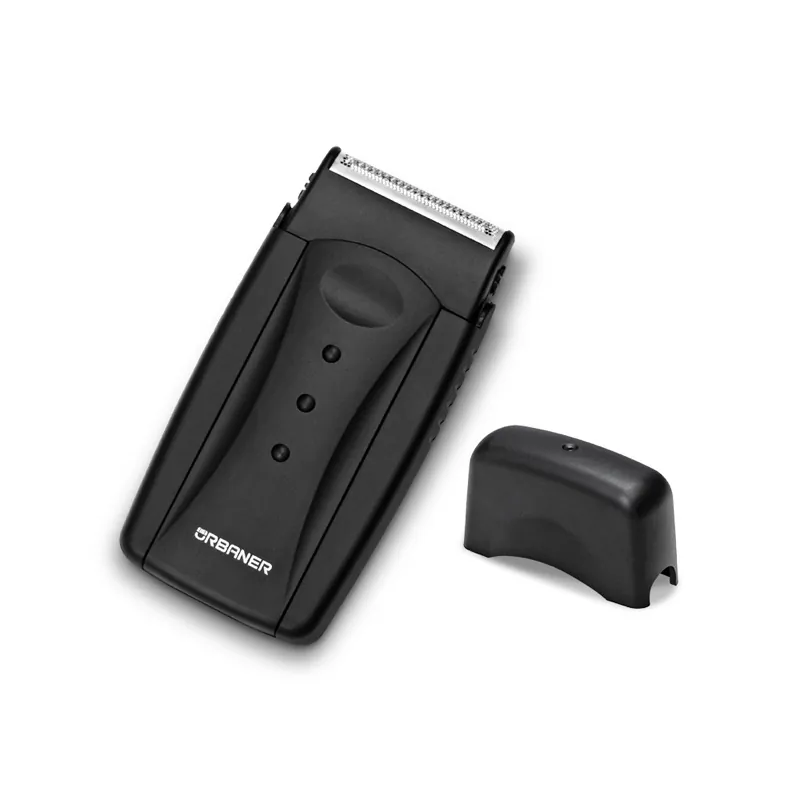
KUNNEX’s current platform in this category is the MB-043 Mini Pocket Shaver. The specification set reads like a checklist of the channel requirements above:
| Channel requirement | MB-043 answer |
|---|---|
| Cabin-baggage and pocket portability | 8 × 4 × 1 cm — smaller than a business card |
| Light enough for gift parcels and travel kits | 47 g |
| No cables, chargers, or lithium logistics | AA × 1 battery operation |
| Enough runtime for a trip | Approximately 90 minutes per cell |
| Close, comfortable shave in a small head | Foil cutting system, manufactured and inspected in-house |
The platform approach matters commercially. Because the MB-043 is an existing, tooled platform, private label customization — logo printing or engraving, custom housing colors, retail gift-box packaging, and manuals in your markets’ languages — does not require new tooling investment. Samples of existing platforms typically ship in 7–14 days, and most private label projects go from inquiry to sellable stock in about three months, which comfortably fits a Q4 gift-season plan started in the first half of the year. The MB-043 sits within our broader shaver line, detailed on the electric shaver manufacturing page.
How should buyers plan packaging and private label for gift sets?
In gift and travel channels, the box does more selling than the device. Three planning points from projects we have manufactured:
- Design the gift box for the shelf it will sit on. Airport retail, department-store gift walls, and e-commerce gift guides each have different size norms and orientation constraints. Decide the channel first, then the box, then the insert.
- Consider bundles deliberately. A pocket shaver pairs naturally with other compact grooming SKUs into a travel kit. Multi-piece gift formats — like the gift-box construction used on our MB-980 3-in-1 grooming kit — typically outperform single-item boxes in seasonal windows, because they justify a higher gift price point.
- Localize the paperwork. Manuals and box copy in the destination language are inexpensive at production time and expensive to retrofit. KUNNEX prints manuals in customer languages as part of standard private label scope.
If you are building a brand around this category from scratch, the sequencing — positioning, platform selection, certification, packaging, then inventory — is covered step by step in our guide on how to start a private label grooming brand, and the commercial mechanics are on the private label program page.
How do you qualify a pocket shaver supplier before ordering?
The qualification process for a small SKU should be no lighter than for a flagship, because a failed gift is a customer you never win back. A practical sequence:
- Sample first, negotiate second. Put samples through real use — daily shaving, a pocket, a carry-on — for several weeks. Existing-platform samples from KUNNEX ship in 7–14 days, so this step costs little time.
- Confirm certifications per destination market. CE and RoHS for the EU, FCC for the US, PSE for Japan, applied per target market and confirmed per model. Gift products cross borders more than most SKUs, so multi-market coverage is worth confirming up front.
- Audit the factory, or have it audited. KUNNEX is ISO 9001 certified, MIT Smile Mark certified, and welcomes factory audits and third-party inspections. A supplier’s reaction to an audit request is itself a data point.
- Check the inspection regime for the blade system. Foil shavers live or die on the cutter. At KUNNEX, blades are hand-checked after grinding and cutting performance is verified batch by batch — the same regime applied across a line built through 30+ years of OEM manufacturing for brands with effectively zero tolerance for complaints.
- Plan quantities realistically. Typical MOQs run 1,000–3,000 units per model, confirmed per project. For a gift-season program across several markets, that volume is usually easy to justify; for a single small test channel, discuss phasing with the factory honestly rather than forcing the number.
Where does the pocket shaver fit in your catalog plan?
Not every brand needs a pocket shaver, but most grooming brands selling into travel, gifting, or impulse channels are leaving margin on the table without one. It is a low-tooling-risk, fast-to-market SKU on a proven platform, with packaging as the main creative investment. KUNNEX has manufactured electric grooming devices in Taiwan since 1977 and ships to 100+ B2B clients across four continents; if the format fits your channel plan, write to sales@kunnex.com — inquiries are answered in English, Japanese, or Mandarin within two business days.
Working on a grooming product? KUNNEX private-labels proven platforms and builds OEM programs from its ISO 9001 factory in Taiwan — samples in 7–14 days.
Talk to the factory