
When a nose trimmer pulls hairs instead of cutting them, the customer does not write a nuanced review about manufacturing tolerances. They write that the product hurts. For a brand, this single failure mode drives more one-star reviews, more returns, and more permanent listing damage than any other complaint in the category—and it is almost entirely a factory problem, decided long before the unit reaches a warehouse. After nearly five decades of building rotary nose and ear trimmers in Taiwan, we can say plainly that pulling is not bad luck and not user error. It is a tolerance failure with a small number of identifiable causes. This article explains each one, so that buyers evaluating suppliers know which questions separate a trimmer that cuts from one that tugs.
Why Does a Nose Trimmer Pull Hairs Instead of Cutting Them?
A rotary nose trimmer works on a shear principle. An outer blade with slots sits over an inner blade that rotates beneath it. Hair enters a slot, and the moving inner edge shears it against the fixed outer edge, exactly as the two blades of a pair of scissors do. The cut is clean only while the two cutting edges remain in continuous, light contact across their whole travel.
Pulling happens when that contact fails. If a gap opens between the inner and outer blade, the hair is trapped and dragged rather than sheared—the same sensation as trying to cut paper with loose scissors. The gap that causes this is measured in microns, far smaller than anything visible to the eye or detectable in a product photograph. That is why two trimmers that look identical, weigh the same, and use the same motor can behave completely differently against skin.
The four things that open that gap
- Grinding tolerance. If either blade surface is ground slightly out of flatness, contact becomes intermittent as the inner blade rotates. The device cuts on part of its travel and pulls on the rest.
- Unmatched blade pairs. Blades are ground in populations with a natural spread. Assembling one random inner blade with one random outer blade produces some pairs that mate well and some that do not.
- Insufficient or inconsistent contact pressure. The spring or seating arrangement that holds the blades together must apply light, even pressure. Too little and the blades separate under load; too much and the motor slows, heat rises, and the edges wear prematurely.
- Motor torque collapse. A weak or fading motor loses rotational speed the moment it meets a thick hair. Below a certain speed, the shear becomes a tug.
Why Does a Trimmer Start Pulling After a Few Weeks?
A different pattern appears in reviews that begin positively and turn negative around week three. Here the device left the factory cutting acceptably, and something changed. Three causes dominate.
Edge wear from soft or unspecified steel
A cutting edge is only as durable as the steel behind it. A specification that says nothing more than “stainless steel” permits a wide range of hardness, and a soft edge rounds off quickly. Our nose and ear trimmer lines specify materials by name—Japanese stainless steel on the MB-061 Premium Ear & Nose Trimmer, for example—because named steel can be verified and behaves consistently across a production run.
Debris packing behind the blade
Cut hair and skin oil accumulate in the blade cavity. As the cavity fills, the inner blade is progressively lifted away from the outer blade, reopening the gap. This is why washability is a cutting-performance feature rather than a convenience feature. The MB-041 Waterproof Nose Trimmer uses a water-suction cleaning function for exactly this reason, and the whole-piece waterproof construction of the MB-061 allows the head to be rinsed rather than brushed.
Battery voltage sag
As a primary cell depletes, delivered voltage falls and motor speed falls with it. A device that cuts well at 1.5 V may pull at 1.1 V. Runtime figures such as the 90 minutes quoted for our AA-powered nose trimmer platforms are only meaningful if the motor still delivers usable torque near the end of that window, which is a motor-selection decision. We use Japanese MABUCHI motors across these lines.
How Do You Stop a Nose Trimmer That Pulls Hairs in Production?
Because the fault is dimensional, it can only be controlled where the dimensions are created. At our New Taipei City factory, blade heads, motors, and battery systems are designed and manufactured in-house, from R&D and tooling through mass production. Buying blade heads on the open market removes the ability to control the one thing that determines whether the product pulls.
The specific controls that matter:
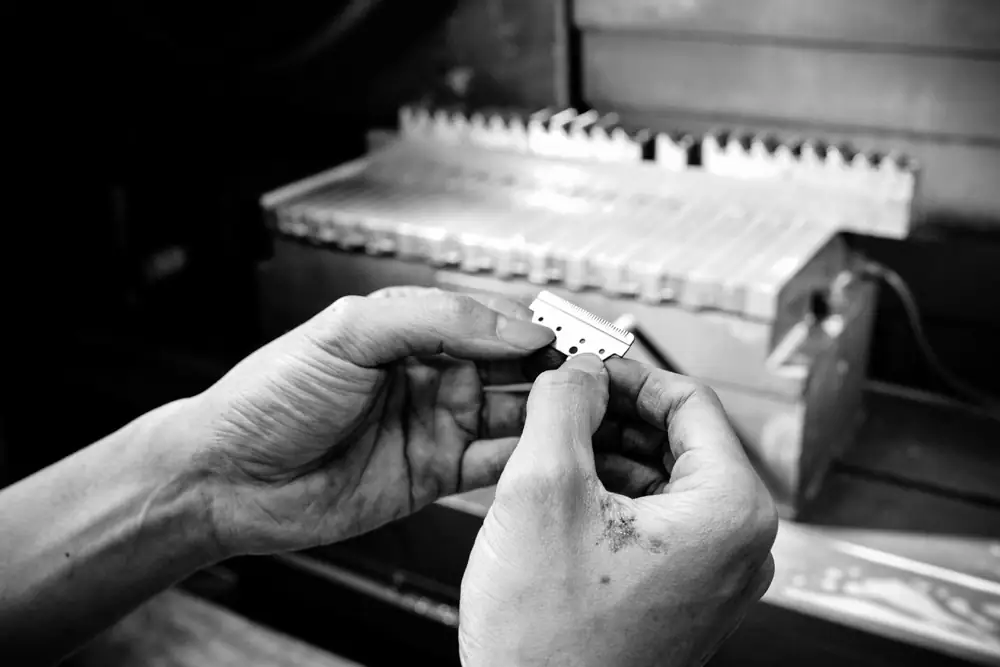
- Hand-checking every blade after grinding. Not a sample—every blade. Sampling detects a bad process; it does not stop a bad unit from reaching a customer.
- Matched blade pairs. Inner and outer blades are paired to mate correctly rather than assembled at random from bins.
- Batch-by-batch cutting verification. Actual cutting performance is tested through the run, not assumed from the drawing.
- Optical inspection before packing. A final check on edge and assembly condition before the unit enters its box.
What Should a Buyer Ask a Supplier?
The following questions are difficult to answer vaguely, which is what makes them useful. A supplier that controls its own blade process will answer each one in a sentence; a supplier that buys blade heads on the open market will answer in generalities (we sell those heads ourselves, as blade modules, which is why we can), because the information genuinely sits somewhere else. That difference in answer quality, rather than any claim about materials, is usually the most reliable early signal a buyer gets.
| Question | Answer that predicts pulling | Answer that predicts clean cutting |
|---|---|---|
| Who makes the blade head? | Purchased; supplier may change | Ground in-house on owned equipment |
| How are blade pairs assembled? | Randomly from bins | Matched pairs, hand-checked after grinding |
| What steel is specified? | “Stainless steel” | Named grade, e.g. Japanese stainless or high-carbon steel |
| How is cutting verified? | Visual check at assembly | Batch-by-batch cutting tests plus optical inspection |
| How does the user clean it? | Brush only | Washable head or water-suction cleaning |
| May we inspect during production? | Case by case | Audits and third-party inspections welcome |
For platform specifications, materials, and customization options across our rotary nose and ear range, see the nose hair trimmer manufacturing page. If you are still shortlisting suppliers, our guide on how to choose a nose hair trimmer manufacturer turns these questions into a scoring framework, and our contract manufacturing page documents the grinding and inspection equipment behind these controls.
Why a Nose Trimmer That Pulls Hairs Deserves Disproportionate Attention
Most product faults annoy a customer. Pulling hurts one, in a sensitive place, within seconds of first use. That combination produces immediate returns rather than quiet dissatisfaction, and returns in the nose trimmer category tend to arrive with vivid review text that suppresses conversion for every future buyer. A brand can recover from a mediocre battery life claim. It rarely recovers from a review saying the product tore hair out.
The reassuring part is that this is one of the most controllable defects in grooming devices, provided the factory owns its blade process. If you are specifying a nose or ear trimmer program, send your target volume and market to sales@kunnex.com. Samples of existing platforms typically ship in 7–14 days, and we answer within two business days in English, Japanese, or Mandarin.
Sending a drawing or a blade specification? We check feasibility against our own grinding and heat-treatment line — and can supply the blade head alone as a designed-in component.
Send a specification Blade module supply