
Every grooming device decision eventually reaches the cutting system, and for most buyers the rotary vs foil blade trimmer question arrives before they have a way to answer it. The three systems in common use — rotary cutting heads, oscillating foil shavers, and reciprocating linear blade sets — are not better or worse than one another. They solve different problems, at different price points, for different kinds of hair. Choosing the wrong one is not a quality failure; it is a positioning failure, and it usually shows up as a product that works exactly as engineered while disappointing the customer who bought it.
This article explains what each system physically does, where each one wins, and which specification decisions follow once the system is fixed. It is written for private label buyers, distributors, and product managers who need to brief a factory rather than repeat a marketing claim.
What does the rotary vs foil blade trimmer decision actually decide?
All three systems shear hair between two hardened surfaces. What differs is how those surfaces move relative to each other, and therefore how the device meets the skin, how much it can cut per pass, and how it behaves when the hair is wet, coarse, or growing at an awkward angle.
Rotary cutting heads
A rotary head places a slotted outer guard over an inner blade that spins continuously. Hair enters through the slots and is sheared as the inner blade passes. Because the outer guard never touches the cutting edge to the skin, the system is inherently safe against sensitive tissue — which is why it dominates nose and ear trimmers. It cuts fine hair efficiently in short bursts and tolerates rinsing well, since the head is a simple cylinder that disassembles for cleaning. Its limitation is throughput: a rotary head is not designed to clear a dense beard or a full head of hair.
Oscillating foil systems
A foil shaver stretches a thin perforated metal sheet over a cutter block that oscillates side to side beneath it. Hair pushes through the perforations and is cut flush at the foil surface. The result is the closest finish of the three systems, because the cutting edge sits fractions of a millimetre from the skin with only the foil thickness between them. Foil systems suit finishing work: a clean shave, a defined neckline, a travel shaver used on already-short stubble. They are poor at bulk removal and are the most vulnerable to damage, since a dented foil is a scrapped part.
Reciprocating linear blade sets
A reciprocating system runs one toothed blade back and forth across a second, stationary toothed blade. Each pair of passing teeth acts as a small scissor. This is the workhorse of the category: beard trimmers, hair clippers, body groomers, and pet clippers all use it, because it clears volume quickly and works with comb attachments to set a defined cutting length. It does not shave flush — the stationary blade holds the skin a fraction away from the cutting line — which is a safety feature, not a defect.

How do the three cutting systems compare side by side?
| Attribute | Rotary head | Foil system | Reciprocating blade set |
|---|---|---|---|
| Closeness of cut | Trims, does not shave flush | Closest of the three | Defined length via combs |
| Bulk removal speed | Low | Low | High |
| Safety near sensitive skin | Highest — guard shields the edge | High — foil separates edge from skin | High with comb; edge exposed without |
| Coarse or wet hair | Struggles | Struggles | Handles well |
| Cleaning | Simple cylinder, rinses easily | Foil and cutter must be handled with care | Straightforward; combs detach |
| Damage tolerance | High | Lowest — a dented foil is scrap | High |
| Natural product fit | Nose and ear trimmers | Pocket and travel shavers, finishing | Beard trimmers, clippers, body and pet groomers |
The table is a starting point, not a verdict. A single product often combines systems: a multifunction kit may pair a rotary nose head with a reciprocating beard head on one body, which is how the MB-980 3-in-1 grooming kit is configured. Combining systems on a shared platform is usually cheaper than commissioning separate devices, and it is one of the more effective ways to widen a range without multiplying tooling cost.
Where does the rotary vs foil blade trimmer choice change by category?
A practical mapping, based on what each system is physically good at:
- Nose and ear trimming: rotary, without serious competition. The guard geometry is what makes the product safe to use inside a nostril.
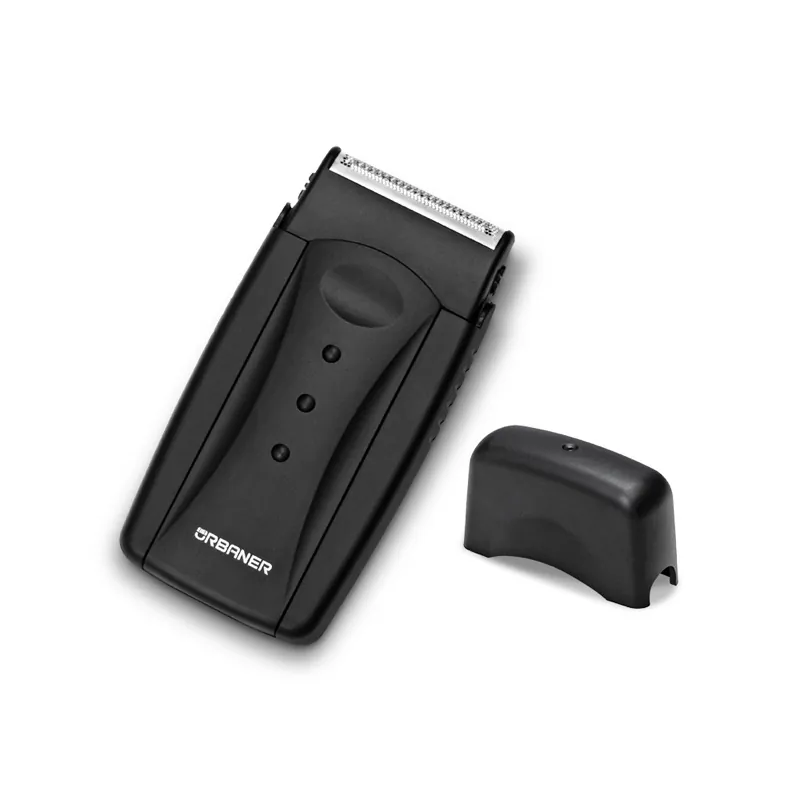
- Travel and pocket shaving: foil. The MB-043 mini pocket shaver is smaller than a business card at 8×4×1 cm and 47 g, and its foil system delivers a close finish in a body that fits a jacket pocket.
- Beard shaping and length control: reciprocating, with comb attachments. The MB-342B runs dual heads — a wide head for bulk and a detail head for edges — with 3, 4, 5, and 6 mm combs.
- Hair clipping: reciprocating, always. Volume removal and defined lengths are the entire job.
- Body grooming: reciprocating with a wide comb range; the MB-333B covers 1–18 mm across eight settings.
- Pet grooming: reciprocating, usually with a ceramic working blade to limit heat during long sessions.
What does the drive system change?
The cutting system determines the blade motion; the drive system determines how that motion is produced and how consistent it stays under load. A rotary head can be driven directly from a motor shaft. Foil and reciprocating systems need rotation converted into a linear stroke, which is done through an eccentric drive or a similar linkage. That conversion is where cheap devices lose their character: an imprecise linkage introduces play, play becomes vibration, and vibration is what a customer describes as a device that feels rattly or noisy.
KUNNEX specifies Japanese MABUCHI motors across its lines and designs the motors, blade heads, and battery systems in-house, so the stroke geometry is engineered against the blade set rather than fitted to whatever module was available. What that integration involves — from R&D and tooling through to mass production under one roof — is set out on the contract manufacturing capabilities page.
What should you specify before asking for a quote?
- The job, not the system. Describe what the end user is trying to achieve — flush shave, defined 3 mm beard, full clip, safe nostril trim. A competent factory will map that to a cutting system faster than you can.
- The hair type and market. Coarse hair, curly hair, wet use, and professional duty cycles all push the specification toward reciprocating systems and more capable blade materials.
- Session length. Anything above a few minutes of continuous running makes blade heat a real consideration, and moves ceramic working blades from a nicety to a feature.
- Sealing and cleaning. Foil systems and reciprocating heads impose different cleaning routines. Decide whether the product is rinsed, brushed, or fully washable before the housing is designed.
- Whether you are badging or building. An existing platform can carry your brand in weeks; a new cutting system means tooling. The distinction is covered in the comparison of private label, OEM, and ODM arrangements.
Get these five right and the rotary, foil, or reciprocating decision usually makes itself. Get them wrong and no amount of blade quality will rescue the product, because the device will be doing a job the customer did not buy it to do.
KUNNEX has manufactured all three cutting systems in Taiwan since 1977, with blade heads, motors, and battery systems built in-house in an ISO 9001 certified factory. Blade heads for any of the three systems can also be supplied on their own as component modules. Existing platforms across foil shavers, rotary trimmers, and reciprocating clippers can be reviewed on the electric shaver and hair clipper pages, and samples of existing platforms typically ship in 7–14 days. Enquiries to sales@kunnex.com are answered in English, Japanese, or Mandarin within two business days.
Sending a drawing or a blade specification? We check feasibility against our own grinding and heat-treatment line — and can supply the blade head alone as a designed-in component.
Send a specification Blade module supply