
Ask ten grooming-device suppliers what steel their blades are made from and you will get ten confident answers — and very little context for judging them. A practical trimmer blade steel comparison matters more to a private label buyer than almost any other line on a specification sheet, because the blade is the part your customer touches, feels, and reviews. It determines how the device cuts on day one, how it cuts after eighteen months, whether it pulls hair, whether it heats up during a long session, and how often your support inbox fills with complaints. This guide compares the three blade material families used across serious grooming production — Sandvik Swedish stainless steel, Japanese high-carbon steel, and ceramic — plus standard Japanese stainless, and explains how to match each one to a product category and a price position.
The comparison below reflects the materials KUNNEX runs in its own Taiwan factory, where blade heads are ground, matched, and inspected in-house rather than bought as finished modules — the same heads we also supply to other brands as precision blade modules. That matters for a reason we will return to: the steel grade on the datasheet is only half the story. The grinding and pairing process is the other half.
Why does blade steel matter so much in a trimmer blade steel comparison?
A trimmer or clipper cuts with a scissor action. A moving blade oscillates against a stationary blade, and each pair of passing teeth shears hair the way scissors do. For that action to work, three things must hold true at once:
- Edge hardness. The cutting edges must be hard enough to shear hair cleanly for hundreds of hours without rounding over. A dulled edge does not stop cutting — it starts pulling, which users describe, accurately, as painful.
- Dimensional stability. The two blades must stay flat and in tight contact. Warping of even a few hundredths of a millimetre opens a gap that traps hair instead of cutting it.
- Corrosion resistance. Grooming devices live in bathrooms and, increasingly, in showers. A steel that micro-pits in humid conditions loses its edge chemistry long before it loses its edge geometry.
No single material maximises all three. Every blade steel is a trade-off, which is why a competent manufacturer runs several materials across its product lines instead of one “house steel” for everything.
What are the main blade materials used in grooming devices?
Sandvik Swedish stainless steel
Sandvik is a Swedish specialty-steel producer whose strip steel is a reference material in razors and precision blades. Its stainless grades combine high, consistent hardness with strong corrosion resistance, and — critically for high-volume manufacturing — exceptional batch-to-batch consistency. When a coil of Sandvik strip arrives, its hardness and composition are where the last coil was, which means the grinding process does not need re-tuning and the finished edges behave predictably. KUNNEX uses Sandvik steel in hair clippers such as the MB-034 entry-level clipper and the MB-333B body shaver and trimmer, where blades meet moisture, skin contact, and long duty cycles.
Japanese high-carbon steel
High-carbon steel is the traditional cutlery choice: more carbon means a harder, keener edge that holds its geometry under sustained cutting load. The trade-off is corrosion — plain carbon steel rusts readily. In practice, manufacturers manage this with coatings, surface treatment, and product design that lets the head dry properly. Japanese high-carbon steel is a strong fit for beard trimmers and clippers where cutting performance on coarse hair is the headline feature; KUNNEX runs it in the MB-342B waterproof beard trimmer, the MB-980 3-in-1 grooming kit, and the MB-134 dual-head hair clipper.
Japanese stainless steel
Standard Japanese stainless is the balanced option: good hardness, good corrosion resistance, and cost-efficiency at volume. It is the sensible default for nose and ear trimmers — devices that are rinsed constantly, used in short sessions, and cut fine hair rather than dense beard growth. The MB-061 premium ear and nose trimmer uses a Japanese stainless steel blade for exactly this reason. If you are specifying a rotary nose trimmer for a mid-market price point, this material family is usually the right starting assumption; the guide on choosing a nose hair trimmer manufacturer covers the rest of that category’s specification questions.
Ceramic working blades
Ceramic is not steel at all, and its value comes from a different physical property: friction and heat. A ceramic working blade running against a steel stationary blade generates roughly 70 percent less heat than a steel-on-steel pair. For short grooming sessions this is a nicety. For long sessions — a full haircut, professional back-to-back use, or pet grooming where a nervous animal reacts to a warm blade — it is a genuine selling feature. Ceramic also cannot rust. Its limitation is brittleness: a dropped ceramic blade can chip where steel would dent. KUNNEX pairs ceramic working blades with Sandvik steel in the MB-133 barber-grade clipper, and uses ceramic blades across its pet clipper line, including the MB-066 two-speed pet clipper.
How do Sandvik, Japanese high-carbon, and ceramic blades compare side by side?
| Property | Sandvik stainless | Japanese high-carbon | Japanese stainless | Ceramic |
|---|---|---|---|---|
| Edge sharpness and retention | High, very consistent | Highest of the steels | Good | High, long-wearing |
| Corrosion resistance | Strong | Requires coating and design care | Strong | Immune to rust |
| Heat in extended use | Moderate | Moderate | Moderate | ~70% less heat vs. steel pair |
| Impact tolerance | High | High | High | Lower; can chip if dropped |
| Relative blade cost | Premium | Mid to premium | Mid | Premium |
| Natural fit | Clippers, body shavers, wet-use devices | Beard trimmers, clippers, multi-kits | Nose and ear trimmers | Barber-grade clippers, pet clippers |
Two readings of this table are worth resisting. The first is “high-carbon is best because it is sharpest.” Sharpness matters most where the device meets coarse hair under load; on a nose trimmer it buys you little and costs corrosion headroom. The second is “ceramic is best because it runs cool and never rusts.” Cool running is decisive in clippers and pet devices and nearly irrelevant in a twenty-second nose-trim session. The right answer is always category-specific — which is why the material mix across a manufacturer’s catalogue tells you more than any single model’s spec line. You can see how these materials map across a full clipper range on the hair clipper product line, where Sandvik, Japanese high-carbon, and ceramic blades each appear in the models their properties suit.
Why does grinding and blade matching matter as much as the steel grade?
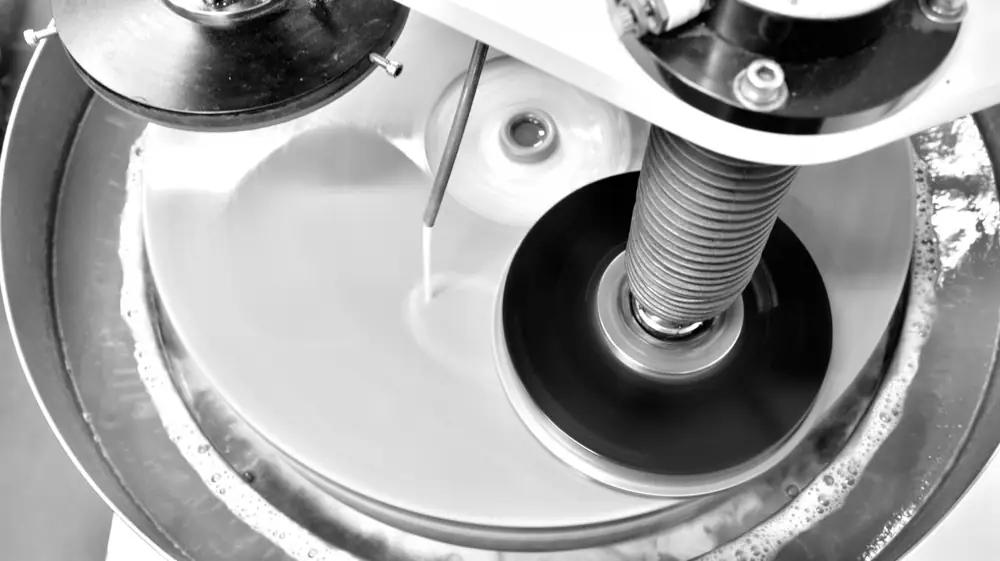
Here is the uncomfortable truth behind every trimmer blade steel comparison: two factories can buy the identical steel and ship blades that perform nothing alike. The steel mill delivers hardness and composition. The factory delivers edge geometry, surface finish, flatness, and — most overlooked of all — the pairing of moving and stationary blades.
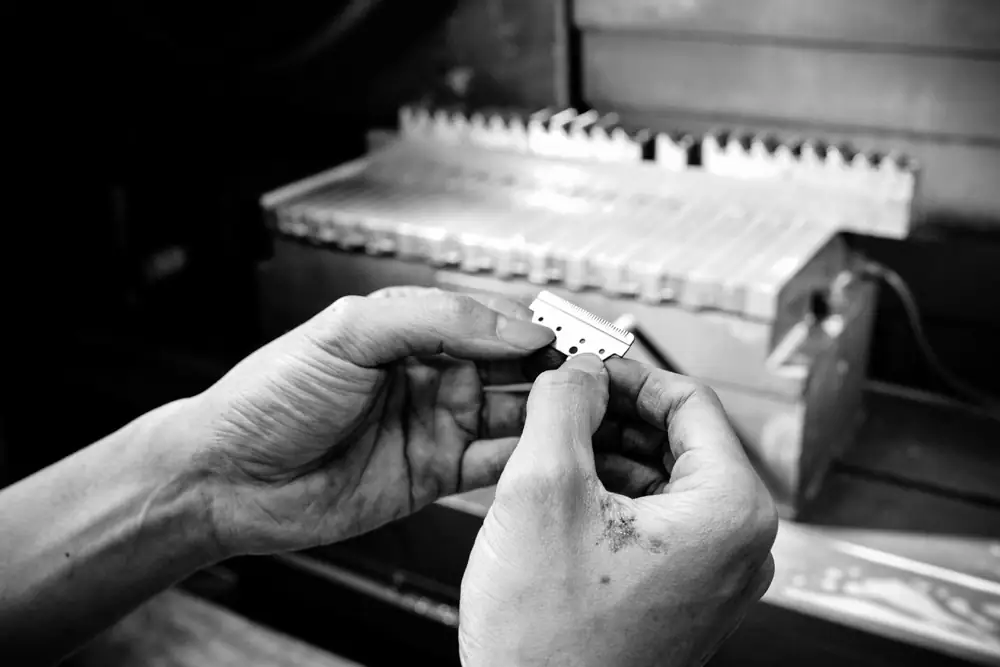
Because the cutting action depends on tight, even contact between two blades, the pair matters more than either part alone. A slightly convex moving blade against a slightly concave stationary blade can cut beautifully; two individually “in-spec” blades assembled at random can pull hair. This is why KUNNEX hand-checks every blade after grinding and matches blade pairs deliberately rather than assembling them from random bins, then verifies cutting performance batch by batch and runs optical inspection before packing. These steps are labour, and labour is cost — but they are the difference between a spec sheet and a product that still cuts cleanly at month eighteen.
For buyers, the practical lesson is to audit the process, not just the material certificate:
- Ask where blades are ground. A factory that grinds in-house controls edge geometry; a factory that buys finished blade modules controls only incoming inspection. There is a full overview of what in-house blade, motor, and battery capability looks like on the contract manufacturing capabilities page.
- Ask how pairs are assembled. “Matched pairs” and “random assembly” are different processes with different complaint rates.
- Ask how cutting performance is verified. Per-batch cutting tests catch drift that dimensional checks miss.
- Test aged samples, not just fresh ones. Run a sample daily for a month, rinse it, leave it wet occasionally. Edge retention and corrosion behaviour reveal themselves quickly under honest abuse.
Which blade material should your product use?
A reasonable shortcut, category by category:
- Nose and ear trimmers: Japanese stainless steel. Corrosion resistance and fine-hair performance at a sensible cost.
- Beard trimmers and multifunction kits: Japanese high-carbon steel, with proper coating and a waterproof design that drains and dries.
- Hair clippers, mid-market: Sandvik or Japanese high-carbon steel depending on price position.
- Hair clippers, barber-grade or premium: ceramic working blade against a Sandvik stationary blade — cool running becomes a marketable feature.
- Body shavers and wet-use devices: Sandvik stainless, for skin contact and constant rinsing.
- Pet clippers: ceramic, because sessions are long and animals notice blade heat before owners do.
Treat these as starting assumptions, not rules. A premium nose trimmer positioned as a gift item may justify a step up in material; an entry-level clipper for occasional home use may not need barber-grade ceramic. The point of understanding the materials is to make that call deliberately — and to recognise when a supplier’s quote is cheap because the blade is where the cost was taken out. Blade quality is one of the clearest places where the difference between manufacturing ecosystems shows up in the finished product; the comparison of Taiwan versus low-cost manufacturing ecosystems covers that broader decision in detail.
After 49 years of grinding, matching, and inspecting blades in Taiwan — including 30-plus years as an OEM partner to international brands with effectively zero tolerance for customer complaints — KUNNEX’s position is simple: specify the steel for the category, then verify the factory’s process around it. If you would like to evaluate the materials directly, samples of existing platforms typically ship in 7–14 days; factory audits and third-party inspections are welcome. Reach the team at sales@kunnex.com or through the contact page, with responses in English, Japanese, or Mandarin within two business days.
Sending a drawing or a blade specification? We check feasibility against our own grinding and heat-treatment line — and can supply the blade head alone as a designed-in component.
Send a specification Blade module supply