
Most companies that build a personal-care portfolio treat pet grooming as somebody else’s category. It sits in a different aisle, sells through different buyers, and rarely appears in the same trade shows — so the case for becoming a pet grooming products distributor is often never examined at all. That is a mistake worth revisiting, because the manufacturing base, the technical questions, and the after-sales pattern are close enough to human grooming devices that an existing distributor can add the line with far less friction than a genuinely new category would demand.
This article looks at why the channel is overlooked, what actually differs between pet and human devices, which buyers sit behind the category, and what to verify in a supplier before committing shelf space or warehouse capital.
Why is the pet grooming products distributor channel overlooked?
Three habits keep the category off the agenda. The first is organisational: personal care and pet supply usually report to different buyers inside the same retail group, so a distributor calling on one never hears the other’s requirements. The second is assumption — pet clippers are widely believed to be simple, low-margin commodity items, which is true of the cheapest tier and false of the professional tier. The third is technical caution: distributors who have handled returns on cheap clippers know how badly the category behaves when the device is wrong, and conclude the category is the problem rather than the sourcing.
That last point is the important one. Pet clippers fail in specific, predictable ways — heat, noise, blade drag on matted coats, batteries that die mid-groom. Each one is a specification failure rather than an inherent flaw in the category, and each one is avoidable at the point of sourcing.
What genuinely differs between pet and human grooming devices?
Session length changes everything
A human beard trim lasts two minutes. A full-body groom on a medium dog can run 45 minutes or more, often back to back if the operator is a professional. Continuous running builds blade heat, and an animal reacts to a warm blade long before its owner notices. This is the central reason ceramic working blades matter in this category: a ceramic blade running against steel generates roughly 70 percent less heat than a steel-on-steel pair.
Runtime specifications are not cosmetic
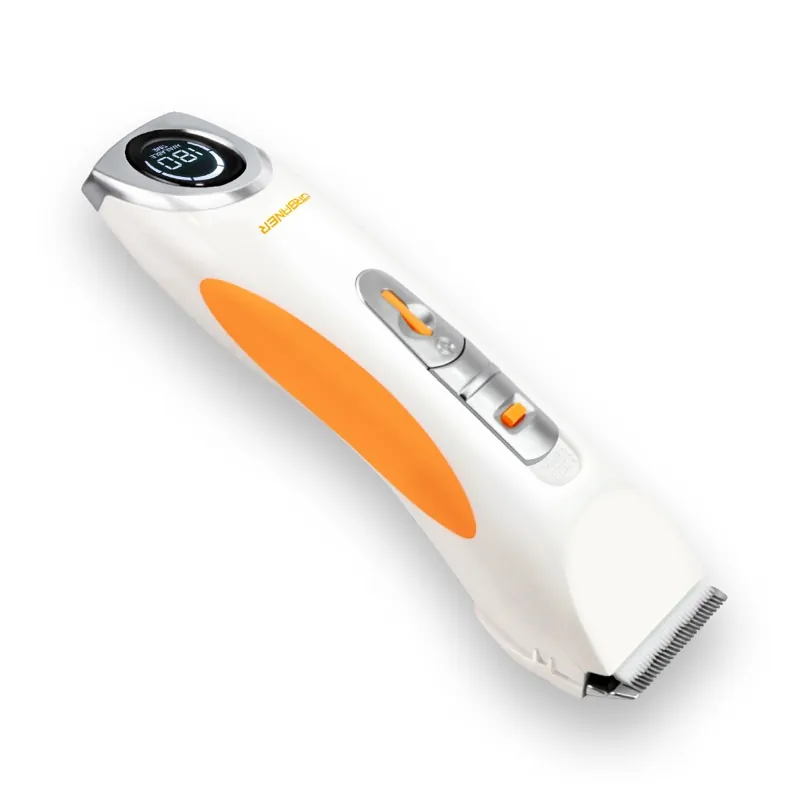
In personal care, a battery that fades early is an annoyance. In pet grooming, a clipper that dies halfway through a groom leaves a half-shaved animal and a customer who will not return. The MB-066 professional clipper runs 180 minutes on Ni-MH; the MB-033 offers corded and cordless operation so the device can be plugged in when a session overruns. Those are commercial specifications, not engineering trivia.
Noise and vibration are a safety feature
A nervous animal that flinches at a loud clipper turns a routine groom into a struggle, with risk to the animal and the handler. Motor quality and drive precision carry more weight here than in any human device.
Blade safety works differently
Pets have loose skin, mats, and no ability to hold still on request. Safety blade geometry and a reliable length setting matter more than closeness of cut. The MB-055 full-body clipper uses a ceramic safety blade with a built-in five-step dial from 0.2 to 2.5 mm, which removes the risk of a comb attachment shifting mid-stroke.
Who actually buys through a pet grooming products distributor?
| Buyer | What they need | Product tier |
|---|---|---|
| Professional grooming salons | Long runtime, cool blades, two-speed control, serviceability | Professional |
| Veterinary clinics | Quiet operation, safety blade geometry, easy cleaning | Professional |
| Pet retail chains | Shelf-ready packaging, clear length settings, consistent stock | Consumer to mid |
| Online marketplaces | Review resilience, low return rate, defensible listing claims | Mid to professional |
| Breeders and kennels | Durability, full-body coverage, corded fallback | Professional |
These segments behave differently on price. Professional buyers replace equipment on a cycle and will pay for runtime and cool running because downtime costs them appointments. Consumer buyers are price-led but review-sensitive, which means the cheapest device is frequently the most expensive to distribute once returns and marketplace penalties are counted. A portfolio that covers both tiers — rather than betting on one — tends to be the more resilient position.
How does a pet line fit alongside an existing personal-care range?
For a distributor already carrying trimmers, shavers, and clippers, the operational overlap is substantial:
- Same supplier base. The blade grinding, motor specification, and battery engineering behind a pet clipper are the same disciplines behind a hair clipper. A manufacturer competent in one is usually competent in the other.
- Same certification logic. CE and RoHS for the EU, PSE for Japan, FCC for the United States — applied per target market and confirmed per model, exactly as with personal-care devices.
- Same logistics profile. Comparable carton sizes, comparable battery shipping considerations, comparable warehouse handling.
- Different sales calendar. Pet grooming demand is less concentrated around gifting seasons than personal care, which smooths a portfolio that otherwise peaks in the fourth quarter.
- Different competitive pressure. Fewer distributors are calling on pet buyers with a manufacturer-backed technical story, which makes the first credible conversation easier to have.
There is also a branding decision embedded in the opportunity. A distributor can carry a manufacturer’s existing models under their own labels, or take the same platforms under a private label of its own — adding logo engraving, house colours, and retail packaging without commissioning new tooling. Private label projects on existing platforms typically move from inquiry to sellable stock in about three months, which is fast enough to test the channel within a single planning cycle. The trade-offs between distributing a supplier’s brand and building your own are set out in the guide to starting a private label grooming brand.

What should a pet grooming products distributor verify before committing?
- Blade material and origin. Ask whether the ceramic and steel blades are ground in-house and whether blade pairs are matched rather than randomly assembled. In a category defined by long sessions, blade contact quality is what separates a clipper that stays cool from one that drags and heats.
- Verified runtime, not quoted runtime. Ask under what load the runtime figure was measured, then test it on a sample against a realistic coat.
- Two-speed and thermal behaviour. Run a sample continuously for a full session length and check blade temperature by hand at the end.
- Territory and stock policy. Establish early whether the manufacturer supports territory arrangements and how it handles stock continuity for a line you intend to hold.
- Audit rights. A supplier who welcomes factory audits and third-party inspections is one you can defend to your own buyers.
It is worth being direct about price. A manufacturer running in-house blade grinding, hand-checked blades, batch cutting verification, and optical inspection before packing will rarely be the lowest quote — low-cost supply chains can often quote roughly half the unit price. The argument for the higher number is total cost of quality: returns, review damage, and lost professional accounts that do not come back after one failed groom.
KUNNEX has built electric grooming devices in Taiwan since 1977 and sells into more than twenty countries across four continents, with blade heads, motors, and battery systems designed and manufactured in-house in an ISO 9001 certified factory. In the pet category, the MB-033 and MB-055 are built in that same factory, while the MB-066 professional platform is produced through a qualified manufacturing network under KUNNEX quality inspection. The current models can be reviewed on the pet grooming device line, and distributor and wholesale terms are set out on the partnership page. Samples of existing platforms typically ship in 7–14 days; enquiries to sales@kunnex.com are answered in English, Japanese, or Mandarin within two business days.
Carrying personal-care lines in your market? Ask about URBANER territory availability and wholesale terms — or private-label our platforms under your own brand.
Ask about distribution