
Two trimmer blades can be stamped from the same coil of Swedish steel, on the same press, in the same week—and still perform completely differently on hair. The difference is rarely the material. It is almost always the grinding. Blade grinding tolerance, the tiny allowable deviation in flatness, edge geometry, and surface finish when a blade is ground, is the single largest factor separating a trimmer that cuts cleanly for years from one that pulls and snags within weeks. For B2B buyers evaluating grooming device manufacturers, understanding this one parameter turns a vague conversation about “quality” into a concrete conversation about process control.
KUNNEX has ground trimmer and clipper blades in its own Taiwan factory since 1977, and nearly five decades of OEM work for internationally recognized brands has taught us a simple truth: buyers who ask about grinding tolerance almost never end up with a returns problem. (For brands that want the ground blade head alone rather than a finished device, we supply it as a designed-in component.) This article explains what the term means, why it matters more than the steel grade on the datasheet, and what to ask any supplier before you commit to a purchase order.
What Is Blade Grinding Tolerance?
An electric trimmer cuts hair the way scissors do, not the way a razor does. A moving blade oscillates against a stationary blade, and each pair of passing teeth shears the hair caught between them. For that shearing action to work, the two blade surfaces must sit almost perfectly flat against each other along their entire contact face.
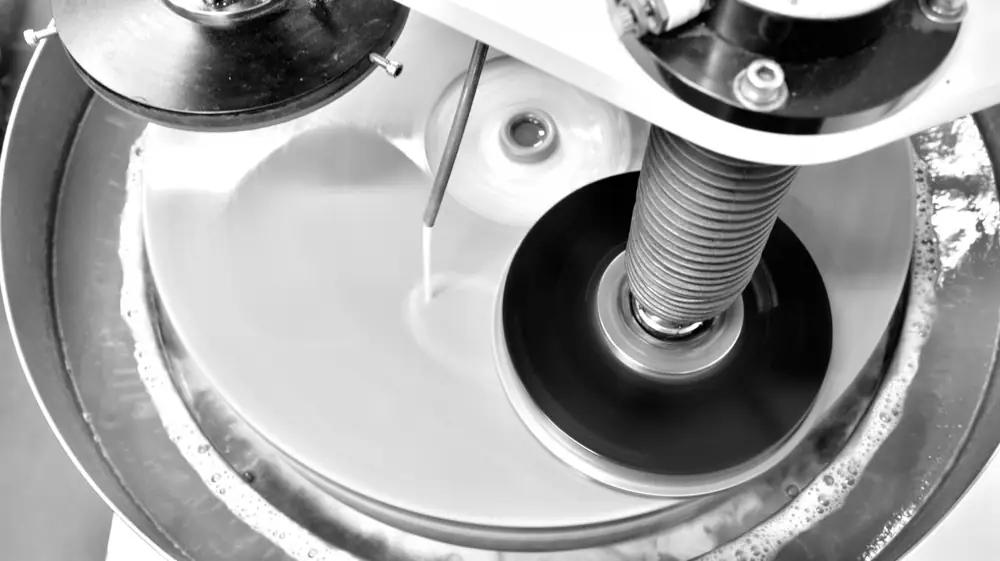
Blade grinding tolerance is the permitted deviation from that ideal. After a blade is stamped and heat-treated, its working face is ground and lapped to bring three characteristics within specification:
- Flatness — how much the contact surface may deviate from a true plane across its width. Grinding for cutlery-grade shear surfaces is typically controlled at the micron level, far tighter than general sheet-metal work.
- Edge geometry — the angle and consistency of each tooth’s cutting edge. Every tooth must present the same edge to the hair, or some teeth cut while others fold the hair over and pull.
- Surface finish — the smoothness of the ground face. A rough finish increases friction, heat, and wear between the moving and stationary blades.
When people describe a trimmer as feeling “sharp” or “dull,” they are usually describing the combined effect of these three parameters, not the hardness of the steel itself.
Why Does Blade Grinding Tolerance Matter More Than Blade Material?
Material grades are easy to specify and easy to verify on paper, so purchasing conversations tend to revolve around them. Sandvik Swedish stainless steel, Japanese high-carbon steel, and ceramic each bring real advantages, and KUNNEX uses all of them across its product lines. But a premium steel ground loosely will always be outperformed by a modest steel ground precisely.
The reason is mechanical. Shearing only happens where the two blades actually touch. If grinding tolerance drifts, gaps open between the moving and stationary blade. Fine hair—nose hair, stubble, pet undercoat—slides into those gaps instead of being cut, and the user experiences pulling. Pulling is the complaint that drives one-star reviews on grooming devices more reliably than almost any other defect, because the user feels it immediately and personally.
Material still matters, and it interacts with grinding in practical ways:
| Blade material | Practical strength | Grinding consideration |
|---|---|---|
| Sandvik Swedish stainless steel | Corrosion resistance and consistent hardness for washable devices | Holds a precise edge well; rewards tight tolerance with long service life |
| Japanese high-carbon steel | Takes a very keen edge for dense beard and body hair | Edge quality depends heavily on grinding and finishing discipline |
| Japanese stainless steel | Balanced sharpness and durability for daily-use trimmers | Consistent grinding keeps performance uniform across high volumes |
| Ceramic working blade | Runs roughly 70% cooler than steel-on-steel, valuable for long clipper sessions | Hard and brittle; demands controlled grinding to avoid micro-chipping |
In every row of that table, the right-hand column is where cutting performance is actually won or lost. This is why our contract manufacturing capabilities are built around keeping blade R&D, tooling, grinding, and assembly under one roof: when the grinding line and the assembly line share a building, tolerance problems are caught in hours, not discovered in a customer’s warehouse.
What Happens When Grinding Tolerance Slips?
Tolerance drift is rarely dramatic. Grinding wheels wear, fixtures loosen, and a parameter that was comfortably in specification in January is marginal by June. The failure modes appear in a predictable sequence:
- Inconsistent cutting across the head. Some teeth cut, others pull. Users describe the device as needing several passes.
- Heat. Poor surface finish raises friction between blades. On hair clippers used for longer sessions, hot blades become a comfort and safety complaint.
- Noise and vibration. Uneven contact makes the blade set chatter, which users read as cheapness even when the housing and motor are excellent.
- Accelerated wear. High spots on a poorly ground face carry all the load and wear first, so the blade set degrades far faster than its material grade would suggest.
- Returns and reviews. For an Amazon-focused brand, this is the expensive stage—refunds, negative reviews, and in serious cases delisting.
The commercial lesson is that grinding tolerance is invisible at the quotation stage and extremely visible six months after launch. A supplier quoting half the unit price may be saving that money precisely here, where the saving cannot be seen in a sample inspection of ten units. Our article on comparing Taiwan-based manufacturing with low-cost supply chains covers this total-cost-of-quality arithmetic in more depth.
How Does KUNNEX Control Blade Grinding Tolerance?
KUNNEX designs and manufactures blade heads, motors, and battery systems in-house at its ISO 9001 certified factory in New Taipei City. For blades specifically, control rests on four practices:
In-house grinding and lapping
Because grinding is done on our own machines, wheel wear and fixture condition are monitored continuously by the people responsible for the final product. There is no information gap between a subcontractor’s process and our specification.
Hand-checking every blade after grinding
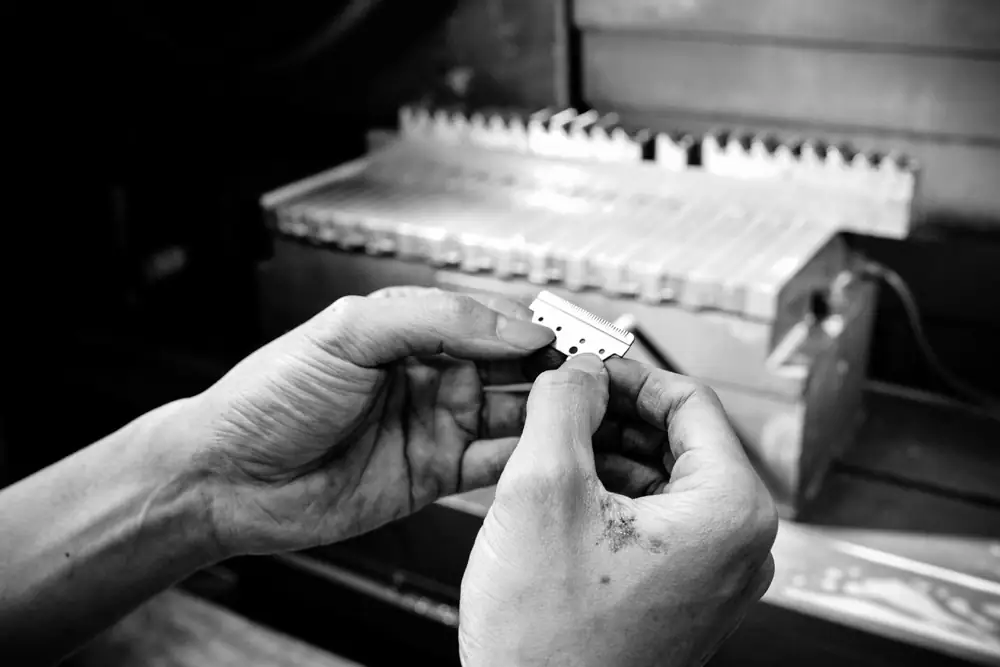
Automated grinding is consistent, but drift is gradual, and a sampling plan can miss its onset. Every blade is hand-checked after grinding, which turns each unit into a data point on the health of the grinding process itself.
Matched blade pairs
Moving and stationary blades are matched as pairs rather than randomly assembled from bins. Two blades that are each individually within tolerance can still pair badly at the extremes of their ranges; matching eliminates that stack-up.
Batch-by-batch cutting verification and optical inspection
Cutting performance is verified on actual hair-like media batch by batch, and finished units pass optical inspection before packing. Together these close the loop: tolerance is controlled at grinding, confirmed at pairing, and proven at the finished-goods stage.
What Should Buyers Ask a Manufacturer About Blade Grinding?
You do not need a metallurgy background to qualify a supplier on this point. Five questions will reveal most of what you need to know:
- Do you grind blades in-house, or buy blade sets from a third party? Neither answer is automatically wrong, but a factory that buys blade sets can only inspect tolerance, not control it.
- How is each blade checked after grinding—sampling or 100%? Ask what happens to blades that fail.
- Are blade pairs matched or assembled from stock? Matching is slower and slightly costlier; a supplier who does it is telling you where their priorities sit.
- How is cutting performance verified per batch? A concrete answer describes a test method, not an adjective.
- Can we audit the grinding line? KUNNEX welcomes factory audits and third-party inspections; hesitation on this question is itself an answer.
Buyers sourcing a specific category may also find our guide on how to choose a nose hair trimmer manufacturer useful, since fine nasal hair is the most demanding test of blade grinding tolerance in the entire grooming category.
Where Does This Leave a Sourcing Decision?
Blade grinding tolerance is the quiet variable behind almost every measurable outcome a grooming brand cares about: cutting feel, review scores, return rates, and repurchase behavior. It cannot be judged from a spec sheet or a single golden sample, which is why the practical proxy is process transparency—in-house grinding, 100% blade checks, matched pairs, batch verification, and an open door for audits.
KUNNEX has held that discipline through 49 years of manufacturing and 30+ years of OEM partnerships in which customer complaints were effectively not an option. If you are specifying a trimmer, clipper, or shaver project and want to see how grinding tolerance is controlled in practice, review our manufacturing capabilities or write to sales@kunnex.com—inquiries are answered in English, Japanese, or Mandarin within two business days.
Sending a drawing or a blade specification? We check feasibility against our own grinding and heat-treatment line — and can supply the blade head alone as a designed-in component.
Send a specification Blade module supply